
|
You entered: planets
 Elements in the Aftermath
26.10.2001
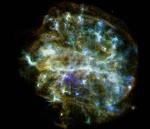
Massive stars spend their brief lives furiously burning nuclear fuel. Through fusion at extreme temperatures and densities surrounding the stellar core, nuclei of light elements like Hydrogen and Helium are combined to heavier elements like Carbon, Oxygen, etc. in a progression which ends with Iron.
 A Scorpius Sky Spectacular
7.04.2019
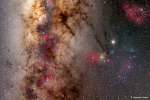
If Scorpius looked this good to the unaided eye, humans might remember it better. Scorpius more typically appears as a few bright stars in a well-known but rarely pointed out zodiacal constellation. To get a spectacular image like this, though, one needs a good camera, color filters, and a digital image processor.
 A High Energy Fleet
25.11.2000
Like a fleet of futuristic starcruisers, NASA's highly successful series of High Energy Astrophysical Observatory (HEAO) spacecraft appear poised over planet Earth. Labeled A, B, and C in this vintage illustration, the spacebased telescopes were known as HEAO-1, HEAO-2, and HEAO-3 respectively.
 Colorful Clouds Of Carina
17.06.2001
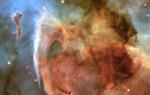
Tumultuous clouds of the Carina Nebula, 8000 light-years away, glow in planet Earth's southern sky. Striking and detailed, this close-up of a portion of the famous nebula is a combination of exposures through six different filters taken with the Hubble Space Telescope's Wide Field Planetary Camera 2 in April of 1999.
 Apollo 17 s Moonship
5.01.2002
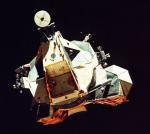
Awkward and angular looking, Apollo 17's lunar module Challenger was designed for flight in the vacuum of space. This sharp picture from the command module America, shows Challenger's ascent stage in lunar orbit.
 N132D and the Color of X Rays
23.05.2002
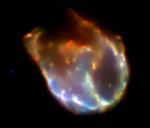
Supernova remnant N132D shows off complex structures in this sharp, color x-ray image. Still, overall this cosmic debris from a massive star's explosive death has a strikingly simple horseshoe shape. While N132D lies 180,000 light-years distant in the Large Magellanic Cloud, the expanding remnant appears here about 80 light-years across.
 Mercury in Accentuated Color
19.03.2008
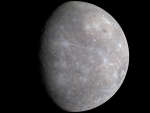
The colors of Mercury are subtle but beautiful. At first glance, our Solar System's innermost planet appears simply black and white, but images that include infrared colors normally beyond human vision accentuate a world of detail. One such image, shown above, was acquired by the robotic MESSENGER spacecraft that swung by Mercury in mid-January.
 Curiosity Before Mars: Seven Minutes of Terror
31.07.2012
Next week at this time, there may be an amazing new robotic explorer on Mars. Or there may be a new pile of junk. It all likely depends on many things going correctly in the minutes after the Mars Science Laboratory mission arrives at Mars and attempts to deploy the Curiosity rover from orbit.
 Northern Mercury
1.12.2012
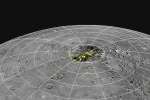
Innermost planet Mercury would probably not be a good location for an interplanetary winter olympics. But new results based on data from the Mercury orbiting MESSENGER spacecraft indicate that it does have substantial water ice in permanently shadowed regions within craters near its north pole.
 Milky Way Over Crater Lake with Airglow
19.06.2013
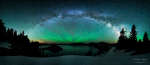
How many different astronomical phenomena have come together to create the above vista? Several. First, in the foreground, is Crater Lake -- a caldera created by volcanism on planet Earth about 7,700 years ago. Next, inside the lake, is water.
|
January February March April May June July August September |
|||||||||||||||||||||||||||||||||||||||||||||||||