
|
You entered: planets
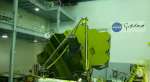 Webb Telescope Mirror Rises after Assembly
8.05.2016
Move over Hubble -- here comes the James Webb Space Telescope (JWST). JWST promises to be the new most powerful telescope in space. In the last month, the 18-segment gold-plated primary mirror for JWST was unveiled. In the featured time-lapse video taken last week, the 6.5-meter diameter mirror was raised to a vertical position.
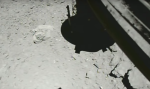 Hayabusa2 Ascends from Asteroid Ryugu
31.10.2018
Will spacecraft Hayabusa2 be able to land safely on asteroid Ryugu? Since arriving in June, pictures show that the surface of kilometer-sized Ryugu is covered with boulders, so that finding a flat enough area for the bus-sized spacecraft to touch down is proving a challenge.
 Flemings Triangular Wisp
26.07.2021
Chaotic in appearance, these tangled filaments of shocked, glowing gas are spread across planet Earth's sky toward the constellation of Cygnus as part of the Veil Nebula. The Veil Nebula itself is a large supernova remnant, an expanding cloud born of the death explosion of a massive star.
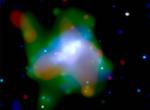 NGC 1569: Heavy Elements from a Small Galaxy
25.07.2002
For astronomers, elements other than hydrogen and helium are sometimes considered to be simply "heavy elements". It's understandable really, because even lumped all together heavy elements make up an exceedingly small fraction of the Universe. Still, heavy elements can profoundly influence galaxy and star formation ... not to mention the formation of planets and people.
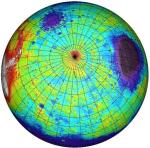 Southern Mars
2.12.1999
This topographical map of the southern hemisphere of Mars was generated using data from the Mars Orbiter Laser Altimeter (MOLA). Flying on the Mars Global Surveyor spacecraft, MOLA has bounced a laser beam off the Martian surface over 200,000,000 times producing a wealth of detailed elevation measurements.
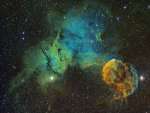 The Elusive Jellyfish Nebula
15.05.2010
Normally faint and elusive, the Jellyfish Nebula is caught in this alluring, false-color, telescopic view. Flanked by two bright stars, Mu and Eta Geminorum, at the foot of a celestial twin, the Jellyfish Nebula is the brighter arcing ridge of emission with dangling tentacles below and right of center.
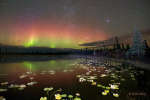 Reflected Aurora Over Alaska
12.02.2013
Some auroras can only be seen with a camera. They are called subvisual and are too faint to be seen with the unaided eye. In the above image, the green aurora were easily visible to the eye, but the red aurora only became apparent after a 20-second camera exposure.
 Perihelion Approaches
14.08.2015
This dramatic outburst from the nucleus of Comet 67P/Churyumov-Gerasimenko occured on August 12, just hours before perihelion, its closest approach to the Sun. Completing an orbit of the Sun once every 6.45 years, perihelion distance for this periodic comet is about 1.3 astronomical units (AU), still outside the orbit of planet Earth (at 1 AU).
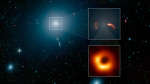 The Galaxy, the Jet, and a Famous Black Hole
14.04.2021
Bright elliptical galaxy Messier 87 (M87) is home to the supermassive black hole captured by planet Earth's Event Horizon Telescope in the first ever image of a black hole. Giant of the Virgo...
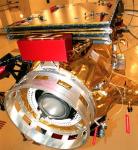 Full Throttle For Deep Space 1
22.09.2001
At full throttle the Deep Space 1 spacecraft's innovative ion drive produces about 1/50th of a pound of thrust ... a force so great that it would just about hold up a piece of paper on planet Earth! Still, powered by solar arrays ion propulsion systems can run continuously.
|
January February March April May June July August September |
|||||||||||||||||||||||||||||||||||||||||||||||||