
|
You entered: image
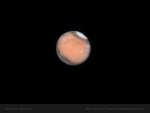 Mars Opposition 2010
29.01.2010
Mars is at opposition tonight, opposite the Sun in planet Earth's sky. Of course, it will be easy to spot because Mars appears close to tonight's Full Moon, also opposite the Sun in Earth's night sky in the constellation Cancer.
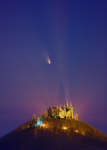 Comet Castle
22.03.2013
The broad dust tail of Comet PanSTARRS (C/2011 L4) has become a familiar sight for many northern hemisphere comet watchers, as the comet fades but rises higher above the western horizon after sunset. This view of the popular comet may seem a little fantastic, though.
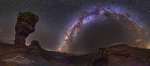 Milky Way and Stone Tree
29.04.2013
What's that next to the Milky Way? An unusual natural rock formation known as Roque Cinchado or Stone Tree found on the Spanish Canary Island of Tenerife. A famous icon, Roque Cinchado is likely a dense plug of cooled volcanic magma that remains after softer surrounding rock eroded away.
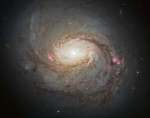 Messier 77
10.05.2013
Face-on spiral galaxy M77 lies a mere 47 million light-years away toward the aquatic constellation Cetus. At that estimated distance, the gorgeous island universe is about 100 thousand light-years across. Also known...
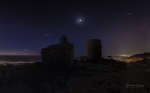 Five Planets at Castell de Burriac
6.02.2016
February's five planet line-up stretches across a clear sky in this predawn scene. A hilltop Castell de Burriac looms in the foreground, overlooking the town of Cabrera de Mar near Barcelona, Spain, planet Earth. The mosaicked, panoramic image looks south.
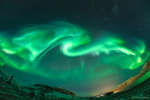 Dragon Aurora over Norway
10.04.2018
What's that in the sky? An aurora. A large coronal hole opened last month, a few days before this image was taken, throwing a cloud of fast moving electrons, protons, and ions toward the Earth.
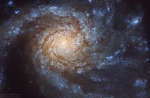 Messier 99
24.06.2021
Grand design spiral galaxy Messier 99 looks majestic on a truly cosmic scale. This recently processed full galaxy portrait stretches over 70,000 light-years across M99. The sharp view is a combination of ultraviolet, visible, and infrared image data from the Hubble Space Telescope.
 Young Stars, Dark Nebulae
10.01.2025
An unassuming region in the constellation Taurus holds these dark and dusty nebulae. Scattered through the scene, stars in multiple star systems are forming within their natal Taurus molecular cloud complex some 450 light-years away.
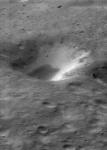 A Two Toned Crater on Asteroid Eros
22.01.2001
What lies beneath the surface of asteroid Eros? This image taken two weeks ago by the robot NEAR spacecraft orbiting the dark asteroid shows a kilometer-wide crater where some type of light material lies beneath some of the darker surface regolith.
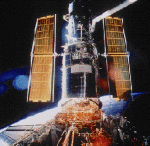 The Orbiting Hubble Space Telescope
10.08.1995
The Hubble Space Telescope (HST) is the largest orbiting public optical telescope in history. Its 2.4 meter diameter reflecting mirror and its perch above Earth's atmosphere allow it to create exceptionally sharp images.
|
January February March April May June July August September |
|||||||||||||||||||||||||||||||||||||||||||||||||