
|
You entered: image
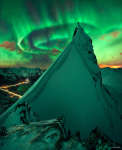 APOD: 2026 February 10 Б In Green Company: Aurora over Norway
10.02.2026
Raise your arms if you see an aurora. With those instructions, two nights went by with, well, clouds -- mostly. On the third night of returning to same peaks, though, the sky not only cleared up but lit up with a spectacular auroral display.
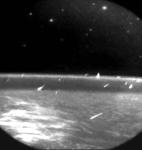 Leonids from Orbit
29.11.2000
Here is what a meteor shower looks like from orbit. During the peak of the 1997 Leonid Meteor Shower, the MSX satellite imaged from above 29 meteors over a 48 minute period entering the Earth's atmosphere. From above, meteors create short bright streaks.
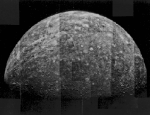 Mercury: Closest Planet to the Sun
14.08.1995
This picture was compiled from images taken by the NASA spacecraft Mariner 10 which flew by the planet three times in 1974. Mercury is the closest planet to the Sun, the second hottest planet (Venus gets hotter), and the second smallest planet (Pluto is smaller).
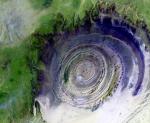 Earths Richat Structure
28.10.2002
What on Earth is that? The Richat Structure in the Sahara Desert of Mauritania is easily visible from space because it is nearly 50 kilometers across. Once thought to be an impact crater, the Richat Structure's flat middle and lack of shock-altered rock indicates otherwise.
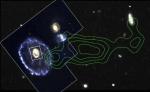 The Trail of the Intruder
24.02.1997
In yesterday's episode our hero, the Cartwheel galaxy, had survived a chance cosmic collision with a small intruder galaxy - triggering an expanding ring of star formation. Hot on the intruder's trail, a team of multiwavelength sleuths have compiled evidence tracking the reckless galaxy fleeing the scene.
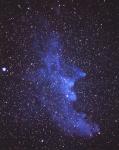 The Witch Head Nebula
9.02.1998
Double, double toil and trouble; Fire burn, and cauldron bubble ... Maybe Macbeth should have consulted the Witch Head Nebula. This suggestively shaped reflection nebula is associated with the bright star Rigel in the constellation Orion. More formally known as IC 2118, the Witch Head Nebula glows primarily by light reflected from Rigel.
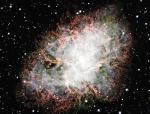 The Crab Nebula from CFHT
28.01.2004
This is the mess that is left when a star explodes. The Crab Nebula, the result of a supernova seen in 1054 AD, is filled with mysterious filaments. The filaments are not only tremendously...
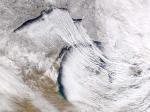 Lake Effect Snow on Earth
30.11.2004
What are those strange clouds stretching out from these lakes? The clouds are caused by cold air moving over a warm water and result in bands of lake-effect snow. The rising bands of moistened, warmed air that drop lake-effect snow alternate with clear bands of falling cold air.
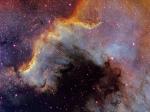 The Cygnus Wall of Star Formation
21.06.2005
The North America Nebula in the sky can do what North Americans on Earth cannot -- form stars. Specifically, in analogy to the Earth-confined continent, the bright part that appears as Central America and Mexico is actually a hot bed of gas, dust, and newly formed stars known as the Cygnus Wall.
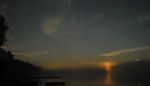 The Sky in Motion
31.12.2008
Still need to come up with a good new year's resolution? Consider one appropriate for 2009, the International Year of Astronomy; just look up -- experience, learn, and enjoy the changing sky. This 4-minute, time-lapse video is composed from a series of 7,000 images highlighting much of what you could see.
|
January February March April May June July August September |
|||||||||||||||||||||||||||||||||||||||||||||||||