
|
You entered: origin
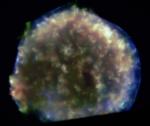 X Rays From Tycho s Supernova Remnant
22.05.2004
In 1572, Danish astronomer Tycho Brahe recorded the sudden appearance of a bright new star in the constellation Cassiopeia. The new star faded from view over a period of months and is believed to have been a supernova, one of the last stellar explosions seen in our Milky Way galaxy.
 APOD: 2024 December 22 Б The Local Fluff
22.12.2024
The stars are not alone. In the disk of our Milky Way Galaxy, about 10 percent of visible matter is in the form of gas called the interstellar medium (ISM). The ISM is not uniform and shows patchiness even near our Sun.
 APOD: 2025 August 9 Б Interstellar Interloper 3I/ATLAS from Hubble
9.08.2025
Discovered on July 1 with the NASA-funded ATLAS (Asteroid Terrestrial-impact Last Alert System) survey telescope in Rio Hurtado, Chile, 3I/ATLAS is so designated as the third known interstellar object to pass through our Solar System. It follows 1I/йOumuamua in 2017 and the comet 2I/Borisov in 2019.
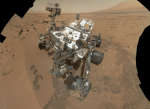 Curiosity Rover at Rocknest on Mars
27.12.2012
What's in this smooth soil on Mars? In late October, NASA's robotic Curiosity rover stopped near a place dubbed Rocknest as it continues to explore Gale Crater on Mars. Rocknest is the group of stones seen near the top left of the above image -- just to the left of Curiosity's mast.
 APOD: 2025 July 17 Б 3I/ATLAS
17.07.2025
Discovered on July 1 with the NASA-funded ATLAS (Asteroid Terrestrial-impact Last Alert, System) survey telescope in Rio Hurtado, Chile, 3I/ATLAS is so designated as the third known interstellar object to pass through our Solar System It follows 1I/йOumuamua in 2017 and the comet 2I/Borisov in 2019.
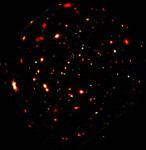 The Cosmic X-Ray Background
9.11.2000
Early on, x-ray satellites revealed a surprising cosmic background glow of x-rays and astronomers have struggled to understand its origin. Now, peering through a hole in the obscuring gas and dust...
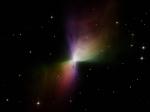 The Boomerang Nebula in Polarized Light
14.09.2005
Why did the Boomerang Nebula form? The symmetric cloud dubbed the Boomerang appears to have been created by a high-speed wind of gas and dust blowing from an aging central star at speeds of nearly 600,000 kilometers per hour.
 HH 222: The Waterfall Nebula
24.10.2011
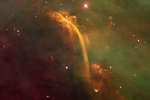
What created the Waterfall Nebula? No one knows. The structure seen in the region of NGC 1999 in the Great Orion Molecular Cloud complex is one of the more mysterious structures yet found on the sky. Designated HH-222, the elongated gaseous stream stretches about ten light years and emits an unusual array of colors.
 LIGO Virgo GW170814 Skymap
28.09.2017
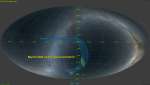
From around planet Earth three gravitational wave detectors have now reported a joint detection of ripples in spacetime, the fourth announced detection of a binary black hole merger in the distant Universe. The event...
 Phobos: Doomed Moon of Mars
25.11.2018
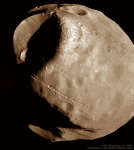
This moon is doomed. Mars, the red planet named for the Roman god of war, has two tiny moons, Phobos and Deimos, whose names are derived from the Greek for Fear and Panic. The origin of the Martian moons is unknown, though, with a leading hypothesis holding that they are captured asteroids.
|
January February March April May June July August |
||||||||||||||||||||||||||||||||||||||||||||||||||||||||