
|
You entered: image
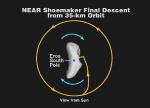 Approaching Asteroid Eros
12.02.2001
Today, at about 3 pm EST, the first human-made spacecraft is scheduled to touchdown on an asteroid. At an impact speed of 8 kilometers per hour, it is most probable that the robot spacecraft NEAR-Shoemaker will not survive its planned collision with 433 Eros.
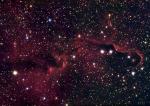 The Elephant s Trunk in IC 1396
20.07.2001
Like a picture from a galactic Just So Story, the Elephant's Trunk Nebula winds through the emission nebula and young star cluster complex IC 1396, in the high and far off constellation of Cepheus. Bright swept-back ridges compose the suggestive form, outlining pockets of interstellar dust and gas.
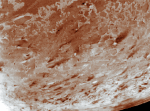 Geysers on Triton
5.08.1995
In August of 1989 NASA's Voyager 2 spacecraft passed by Neptune, the most distant of the solar system's gas giant planets. Its encounter with Neptune climaxed with its closest approach to Neptune's largest moon Triton.
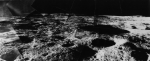 Surveyor Hops
22.11.1997
This panorama of the cratered lunar surface was constructed from images returned by the US Surveyor 6 lander. Surveyor 6 was not the first spacecraft to accomplish a soft landing on the Moon ... but it was the first to land and then lift off again!
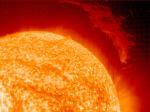 A Prominent Solar Prominence from SOHO
30.03.2004
One of the most spectacular solar sights is a prominence. A solar prominence is a cloud of solar gas held above the Sun's surface by the Sun's magnetic field. Last month, NASA's Sun-orbiting SOHO spacecraft imaged an impressively large prominence hovering over the surface, pictured above.
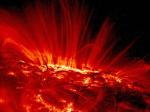 Sunspot Loops in Ultraviolet
10.10.2004
It was a quiet day on the Sun. The above image shows, however, that even during off days the Sun's surface is a busy place. Shown in ultraviolet light, the relatively cool dark regions have temperatures of thousands of degrees Celsius.
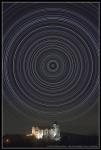 Star Trails Over Vienna
14.07.2005
As the Earth spins on its axis, the sky seems to rotate around us. This motion, called diurnal motion, produces the beautiful concentric trails traced by stars during time exposures. In the middle...
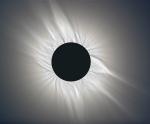 The Crown of the Sun
7.04.2006
During a total solar eclipse, the Sun's extensive outer atmosphere or corona is an awesome and inspirational sight. The subtle shades and shimmering features of the corona that engage the eye span a brightness range of over 10,000 to 1, making them notoriously difficult to capture in a single picture.
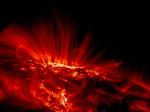 Sunspot Loops in Ultraviolet
11.06.2006
It was a quiet day on the Sun. The above image shows, however, that even during off days the Sun's surface is a busy place. Shown in ultraviolet light, the relatively cool dark regions have temperatures of thousands of degrees Celsius.
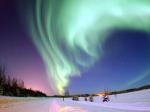 Aurora Over Alaska
9.04.2007
Higher than the highest mountain, higher than the highest airplane, lies the realm of the aurora. Aurora rarely reach below 60 kilometers, and can range up to 1000 kilometers. Aurora light results from solar shockwave causing energetic electrons and protons to striking molecules in the Earth's atmosphere.
|
January February March April May June July August September |
|||||||||||||||||||||||||||||||||||||||||||||||||