
|
You entered: image
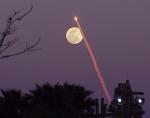 Shuttle Moon
12.05.2001
As a gorgeous full Moon rose above the eastern horizon on February 7, the Space Shuttle Atlantis streaked skyward towards an orbital rendezvous with the International Space Station. Watching from Orlando, Florida, about...
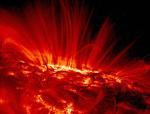 Sunspot Loops in Ultraviolet
8.05.2002
It was a quiet day on the Sun. The above image shows, however, that even during off days the Sun's surface is a busy place. Shown in ultraviolet light, the relatively cool dark regions have temperatures of thousands of degrees Celsius.
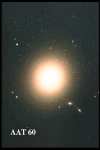 Elliptical Galaxy M87
13.09.1995
Elliptical galaxy M87 is a type of galaxy that looks much different than our own Milky Way Galaxy. But even for an elliptical galaxy M87 is peculiar. M87 is much bigger than an average...
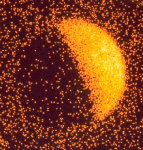 The X-Ray Moon
29.09.1996
This X-Ray image of the Moon was made by the orbiting Roentgen Observatory Satellite (ROSAT) in 1990. It shows three distinct regions: a bright X-ray sky, a bright part of the Moon, and a relatively dark part of the Moon. The bright X-ray sky is due to the diffuse cosmic X-ray background.
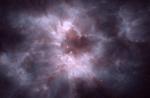 Cocoon of a New White Dwarf
3.12.1996
Like a butterfly, a white dwarf star begins its life by casting off a cocoon that enclosed its former self. In this analogy, however, the Sun would be a caterpillar and the ejected shell of gas would become the prettiest of all!
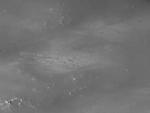 A Martian Lake Bed
11.12.1997
Look closely. In this Mars Global Surveyor image of the Martian surface just south of Schiaparelli crater, dark lines appear to criss-cross light colored depressions. One tantalizing possibility is simply that the feature near...
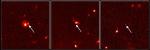 A Distant Destiny
14.01.1998
Watching galaxies recede, observational astronomers of the 20th century discovered an astounding fact - the Universe is expanding. Will it continue to expand forever? The speed of light is finite so looking into the distant Universe is equivalent to looking at the distant past.
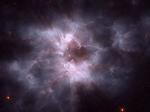 NGC 2440: Cocoon of a New White Dwarf
7.05.2006
Like a butterfly, a white dwarf star begins its life by casting off a cocoon that enclosed its former self. In this analogy, however, the Sun would be a caterpillar and the ejected shell of gas would become the prettiest of all!
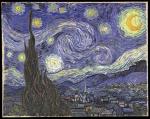 Starry Night
26.06.2006
The painting Starry Night is one of the most famous icons of the night sky ever created. The scene was painted by Vincent van Gogh in southern France in 1889. The swirling style of Starry Night appears, to many, to make the night sky come alive.
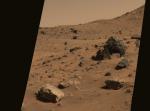 Strangers on Mars
21.07.2006
This view from the winter station of Mars Exploration Rover Spirit, looks across the rock strewn landscape of Gusev Crater. The dark boulders and distant hills are characteristic of the region...
|
January February March April May June July August September |
|||||||||||||||||||||||||||||||||||||||||||||||||