
|
You entered: image
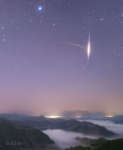 APOD: 2026 January 12 Б Meteor Dust
12.01.2026
What's happening to this meteor? It is shedding its outer layers as it passes through the Earth's atmosphere and heats up. The sudden high temperatures not only cause the bright glow along the dramatic streak but also melt and vaporize the meteor's component rock and ice, creating dust.
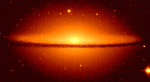 M104: The Sombrero Galaxy
9.11.1995
The famous Sombrero galaxy (M104) is a bright nearby spiral galaxy. The prominent dust lane and halo of stars and globular clusters give this galaxy its name. Something very energetic is going on in the Sombrero's center, as much X-ray light has been detected from it.
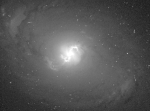 NGC 3393: A Super Spiral?
4.08.1996
A bird? A plane? No, but pictured here is something physically much larger, flying much higher, and moving much faster than either of these. It is, in fact, a Seyfert type 2 spiral galaxy. The "S" is actually a lane of stars, gas and dust circling the core.
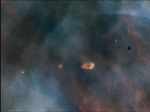 Proplyds: Infant Solar Systems?
17.10.1996
Are planets common in our galaxy? Strong evidence that the answer is "yes" was provided in this 1994 image made by the Hubble Space Telescope . A close-up of the Orion Nebulae, it reveals what seem to be disks of dust and gas surrounding newly formed stars.
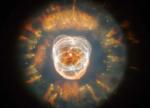 The Eskimo Nebula from Hubble
7.12.2003
In 1787, astronomer William Herschel discovered the Eskimo Nebula. From the ground, NGC 2392 resembles a person's head surrounded by a parka hood. In 2000, the Hubble Space Telescope imaged the Eskimo Nebula. From space, the nebula displays gas clouds so complex they are not fully understood.
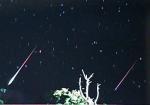 Bright Leonids
19.11.1998
Rich in bright and awesome fireballs, the Leonid Meteor Shower came early this year. In fact, judging from meteor watcher reports the peak came nearly 15 hours earlier than the best predictions. Observers...
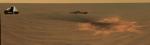 Heat Shield Impact Crater on Mars
9.02.2005
Broken metal and scorched Mars make the impact site of Opportunity's heat shield one of the more interesting sites inspected by the rolling robot. Visible on the image left is the conical outer hull of the shattered heat shield expelled by Opportunity as it plummeted toward Mars last year.
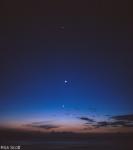 March of the Planets
25.03.1999
This March stargazers have been treated to eye-catching formations of bright planets in western evening skies. On March 3rd, looking toward a beautiful sunset from a beach on the Hawaiian isle of Maui, photographer Rick Scott recorded this fleeting, four-planet "hockey stick" array.
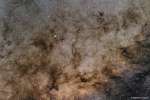 Stars and Dust through Baade s Window
19.12.2007
Billions of stars light up the direction toward the center of our Galaxy. The vast majority of these stars are themselves billions of years old, rivaling their home Milky Way Galaxy in age. Together with interstellar dust, these old stars combine to create this yellowish starscape.
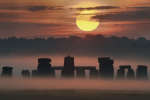 Sunrise Solstice at Stonehenge
21.06.2010
Today the Sun reaches its northernmost point in planet Earth's sky. Called a solstice, the date traditionally marks a change of seasons -- from spring to summer in Earth's Northern Hemisphere and from fall to winter in Earth's Southern Hemisphere.
|
January February March April May June July August September |
|||||||||||||||||||||||||||||||||||||||||||||||||