
|
You entered: satellite
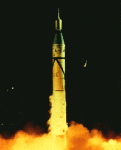 The First Explorer
18.05.1997
The first US spacecraft was Explorer 1. The cylindrical 30 pound satellite was launched (above) as the fourth stage of a Jupiter-C rocket (a modified US Army Redstone ballistic missile) and achieved orbit on January 31, 1958.
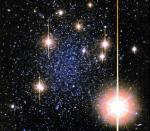 Pegasus dSph: Little Galaxy of the Local Group
22.01.1999
The Pegasus dwarf spheroidal galaxy (Peg dSph) is a small, newly recognized member of the Local Group of Galaxies. Likely a satellite companion of the Local Group's dominant player, the large spiral Andromeda (M31), the Pegasus dwarf galaxy is almost hidden in the glare of relatively bright foreground stars in our own Milkyway.
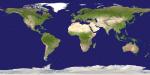 Earth in True Color
5.03.2002
Here are the true colors of planet Earth. Blue oceans dominate our world, while areas of green forest, brown mountains, tan desert, and white ice are also prominent. Oceans appear blue not only because water itself is blue but also because seawater frequently scatters light from a blue sky.
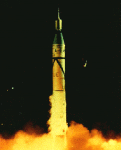 The First Explorer
10.02.1996
The first US spacecraft was Explorer 1. The cylindrical 30 pound satellite was launched (above) as the fourth stage of a Jupiter-C rocket (a modified US Army Redstone ballistic missile) and achieved orbit on January 31, 1958.
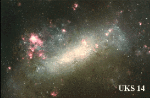 The Large Cloud Of Magellan (LMC)
24.01.1998
Ferdinand Magellan and his crew had plenty of time to study the southern sky during their famous voyage around the world. As a result, two fuzzy cloud-like objects, not visible to northern hemisphere dwellers, are now known as the Clouds of Magellan.
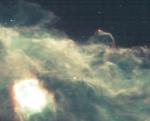 Infrared Horsehead
6.08.1998
This famous cosmic dust cloud was imaged in infrared light by the European Space Agency's Infrared Space Observatory (ISO) satellite. The false-color picture shows the bright infrared emission from dust and molecular gas in part of the Orion star forming region surrounding the Horsehead Nebula.
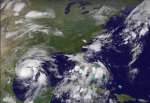 Hurricane Harvey Strengthens
26.08.2017
A large and dangerous hurricane has developed in the Gulf of Mexico. The featured time-lapse video shows Hurricane Harvey growing to Category 4 strength over the past few days, as captured by NASA and NOAA's GOES-East satellite.
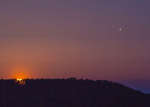 Opposite the Setting Sun
3.05.2018
On April 30, a Full Moon rose opposite the setting Sun. Its yellowish moonglow silhouettes a low tree-lined ridge along Lewis Mountain in this northeastern Alabama skyscape. Sharing the telephoto field-of-view opposite the Sun are Earth's grey shadow, the pinkish Belt of Venus, and bright planet Jupiter.
 APOD: 2023 May 14 Б To Fly Free in Space
14.05.2023
What would it be like to fly free in space? At about 100 meters from the cargo bay of the space shuttle Challenger, Bruce McCandless II was living the dream -- floating farther out than anyone had ever been before. Guided by a Manned Maneuvering Unit (MMU), astronaut McCandless, pictured, was floating free in space.
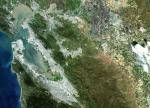 Landsat 7 Views Planet Earth
14.05.1999
Launched last month, NASA's Landsat 7 spacecraft now orbits planet Earth. Looking down from an altitude of 700 km, Landsat 7 can map the planet's surface in visible and infrared bands and resolve features 30 meters across or smaller.
|
January February |
|||||||||||||||||||||||||||||||||||||||||||||||||