
|
You entered: satellite
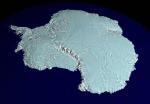 A RADARSAT Map of Antarctica
16.11.1999
It's not easy to make a map of Antarctica. Earth's southern most continent is so cold and inhospitable that much of it remains unexplored. From space, though, it is possible to map this entire region by radar: by systematically noting how long it takes for radio waves to reflect off the terrain.
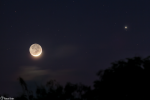 Moons at Twilight
4.02.2022
Even though Jupiter was the only planet visible in the evening sky on February 2, it shared the twilight above the western horizon with the Solar System's brightest moons. In a single exposure...
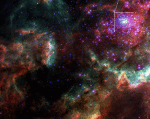 In the Center of 30 Doradus
24.05.1996
In the center of 30 Doradus lies a huge cluster of the largest, hottest, most massive stars known. The center of this cluster, known as R136, is boxed in the upper right portion of the above picture.
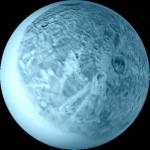 Hamlet of Oberon
31.01.1997
What's in a name? Since 1919, the International Astronomical Union has been charged with the task of establishing "conventional" nomenclature for planets, satellites, and surface features. For the remote Uranian system of moons, namesakes from Shakespearean works have been chosen.
 The Water Vapor Channel
9.05.1998
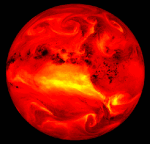
What alien planet's bizarre landscape lurks below these fiery-looking clouds? It's only Planet Earth, of course ... as seen on the Water Vapor Channel. Hourly, images like this one (an infrared image shown in false color) are brought to you by the orbiting Geostationary Operational Environmental Satellites' (GOES) multi-channel imagers.
 A Supernova Starfield
9.02.1999
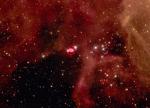
Bright stars don't last forever. A bright star similar to others in this field exploded in a spectacular supernova that was witnessed on Earth in 1987. The result is visible even today as unusual rings and glowing gas. The above picture is a composite of recent images taken over several years.
 The Frothy Milky Way
9.10.1999
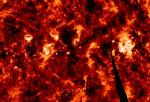
Astronomers have discovered that looking at dust along the plane of our Milky Way Galaxy is a bit like looking into a frothy glass of beer. The dust between stars in our galaxy appears...
 A Large Magellanic Cloud Deep Field
9.04.2008
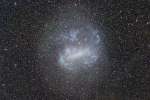
Is this a spiral galaxy? No. Actually, it is the Large Magellanic Cloud (LMC), the largest satellite galaxy of our own Milky Way Galaxy. The LMC is classified as a dwarf irregular galaxy because of its normally chaotic appearance. In this deep and wide exposure, however, the full extent of the LMC becomes visible.
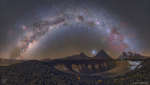 Milky Way over Chilean Volcanoes
21.08.2017
Sometimes, the sky mimics the ground. Taken in 2017 May from the Atacama Desert in Chile, the foreground of the featured image encompasses the dipping edge of the caldera of an extinct volcano. Poetically echoing the dip below is the arch of our Milky Way Galaxy above.
 Hurricane Fran's Approach
20.09.1996
Two weeks ago Hurricane Fran, pictured above, struck the east coast of the United States. Hurricanes are huge swirling storms with cloud systems typically larger than a state. Tropical cyclones, called Hurricanes in Earth's Western Hemisphere and Typhoons in the Eastern Hemisphere, get their immense energy from warm evaporated ocean water.
|
January February |
|||||||||||||||||||||||||||||||||||||||||||||||||