
|
You entered: ion
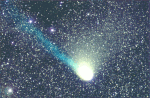 Comet Hale-Bopp Develops a Tail
12.02.1997
Comet Hale-Bopp has quite a tail to tell already. This remarkable comet was first discovered in 1995, even before Comet Hyakutake. Since then, this erupting snowball continues to fall into our inner Solar System and is starting to put on quite a show.
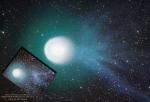 A Tale of Comet Holmes
10.11.2007
A beautiful blue ion tail has become visible in deep telescopic images of Comet Holmes. Pointing generally away from the Sun and also planet Earth, the comet's ion tail is seriously foreshortened by our extreme viewing angle.
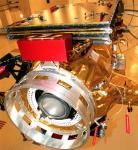 Full Throttle For Deep Space 1
31.08.2000
At full throttle the Deep Space 1 spacecraft's innovative ion drive produces about 1/50th of a pound of thrust ... a force so great that it would just about hold up a piece of paper on planet Earth! Still, powered by solar arrays ion propulsion systems can run continuously.
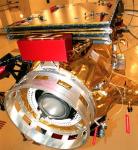 Full Throttle For Deep Space 1
22.09.2001
At full throttle the Deep Space 1 spacecraft's innovative ion drive produces about 1/50th of a pound of thrust ... a force so great that it would just about hold up a piece of paper on planet Earth! Still, powered by solar arrays ion propulsion systems can run continuously.
 APOD: 2024 June 4 Б Comet Pons Brooks Develops Opposing Tails
4.06.2024
Why does Comet Pons-Brooks now have tails pointing in opposite directions? The most spectacular tail is the blue-glowing ion tail that is visible flowing down the image. The ion tail is pushed directly out from the Sun by the solar wind. On the upper right is the glowing central coma of Comet 12P/PonsБBrooks.
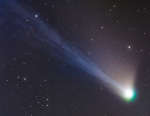 Tails of Comet Lemmon
6.05.2013
What caused the interestingly intricate tails that Comet Lemmon displayed earlier this year? First of all, just about every comet that nears the Sun displays two tails: a dust tail and an ion tail.
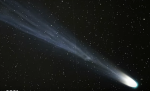 Video: Comet Leonard over One Hour
25.01.2022
Which direction is this comet heading? Judging by the tail, one might imagine that Comet Leonard is traveling towards the bottom right, but a full 3D analysis shows it traveling almost directly away from the camera.
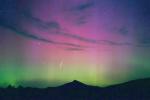 A Perseid Aurora
21.08.2000
Just after the Moon set but before the Sun rose in the early morning hours of August 12, meteors pelted the Earth from the direction of the constellation Perseus, while ions pelted the Earth from the Sun.
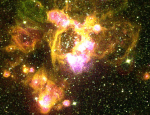 Superbubbles in the LMC
3.07.1996
Why is there a hole in the center of this nebula? A leading explanation is that it is caused by the stellar winds from the stars that live there. Stars - including the Sun - expel electrons, protons, and other charged ions in a steady stream - the stellar wind.
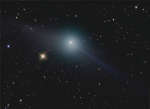 The Opposing Tails of Comet Garradd
28.02.2012
Why does Comet Garradd have two tails? Visible on the left, Comet Garradd's dust tail is composed of ice and dust bits that trial the comet in its orbit around the Sun. Visible...
|
January February |
|||||||||||||||||||||||||||||||||||||||||||||||||