
|
You entered: space
 Fireball!
26.02.1996
On rare but spectacular occasions, fireballs, meteors brighter than the brightest stars, flash through the heavens - sometimes making audible sounds and occasionally surviving to strike the Earth's surface. The path of one such...
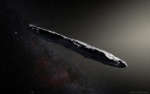 APOD: 2017 November 22 Oumuamua: Interstellar Asteroid
22.11.2017
Nothing like it has ever been seen before. The unusual space rock 'Oumuamua is so intriguing mainly because it is the first asteroid ever detected from outside our Solar System -- although likely many more are to follow given modern computer-driven sky monitoring.
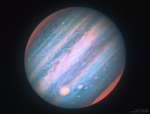 Jupiter in Infrared from Hubble
21.02.2018
Jupiter looks a bit different in infrared light. To better understand Jupiter's cloud motions and to help NASA's robotic Juno spacecraft understand the Hubble Space Telescope is being directed to regularly image the entire Jovian giant.
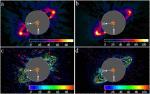 HR 4796A: Not Saturn
5.02.1999
These are not false-color renderings of the latest observations of Saturn's magnificent rings. Instead, the panels show a strikingly similar system on a much larger scale - a ring around the young, Vega-like star, HR 4796A, located about 200 light-years from Earth.
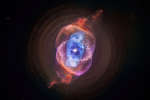 X Rays from the Cats Eye Nebula
4.08.2008
Haunting patterns within planetary nebula NGC 6543 readily suggest its popular moniker -- the Cat's Eye nebula. Starting in 1995, stunning false-color optical images from the Hubble Space Telescope detailed the swirls of this glowing nebula, known to be the gaseous shroud expelled from a dying sun-like star about 3,000 light-years from Earth.
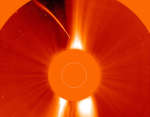 Sungrazer
27.10.2013
Arcing toward a fiery fate, this Sungrazer comet was recorded by the SOHO spacecraft's Large Angle Spectrometric COronagraph(LASCO) on December 23, 1996. LASCO uses an occulting disk, partially visible at the lower...
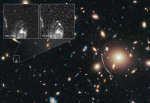 Galaxy Cluster Magnifies Distant Supernova
5.05.2014
How do you calibrate a huge gravitational lens? In this case the lens is the galaxy cluster Abell 383, a massive conglomeration of galaxies, hot gas, and dark matter that lies about 2.5 billion light years away (redshift z=0.187).
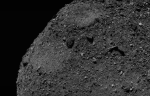 Tagging Bennu: The Movie
3.11.2020
This is what it looks like to punch an asteroid. Last month, NASA's robotic spacecraft OSIRIS-REx descended toward, thumped into, and then quickly moved away from the small near-Earth asteroid 101955 Bennu. The featured video depicts the Touch-And-Go (TAG) sampling event over a three-hour period.
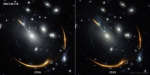 SN Requiem: A Supernova Seen Three Times So Far
2.11.2021
We've seen this same supernova three times -- when will we see it a fourth? When a distant star explodes in a supernova, we're lucky if we see it even once.
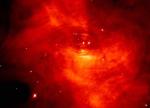 The Pulsar Powered Crab
5.09.1998
In the Summer of 1054 A.D. Chinese astronomers reported that a star in the constellation of Taurus suddenly became as bright as the full Moon. Fading slowly, it remained visible for over a year.
|
January February March April May June July August September |
|||||||||||||||||||||||||||||||||||||||||||||||||