
|
You entered: space
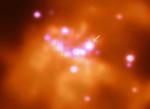 M82 s Middle Mass Black Hole
14.09.2000
Black holes are probably the most bizarre creatures in the modern astronomical zoo. And after years of pondering black holes as either stellar mass objects seen in binary star systems or enormous supermassive black holes at the centers of galaxies, astronomers now have strong evidence
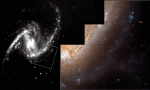 Hubble's Constant And The Expanding Universe (I)
13.05.1996
Our Universe is expanding. Distant galaxies appear to recede from us at ever-increasing speeds. What is the rate of expansion? How long has it been expanding? What will be its ultimate fate? Two groups of astronomers are searching vigorously for answers to these fundamental questions using the Hubble Space Telescope (HST).
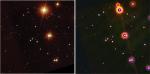 GRB 060218: A Mysterious Transient
27.02.2006
What is it? Something is happening in a small portion of the sky toward the constellation of Aries and telescopes around the globe are tracking an unusual transient there as it changes day by day. No one is sure what it will do next.
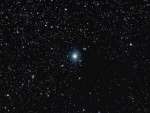 The Mystery of the Fading Star
8.01.2010
Every 27 years Epsilon Aurigae fades, remaining dim for roughly two years before growing bright again. Since the 19th century, astronomers have studied the mystery star, eventually arguing that Epsilon Aur, centered in this telescopic skyview, was actually undergoing a long eclipse by a dark companion object.
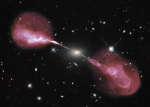 Plasma Jets from Radio Galaxy Hercules A
5.12.2012
Why does this galaxy emit such spectacular jets? No one is sure, but it is likely related to an active supermassive black hole at its center. The galaxy at the image center, Hercules A, appears to be a relatively normal elliptical galaxy in visible light.
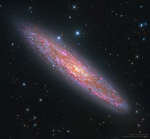 NGC 253: The Silver Coin Galaxy
14.04.2020
NGC 253 is one of the brightest spiral galaxies visible, but also one of the dustiest. Dubbed the Silver Coin for its appearance in smalltelescopes, it is more formally known as the Sculptor Galaxy for its location within the boundaries of the southern constellation Sculptor.
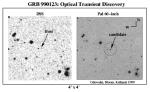 Galaxy And Gamma Ray Burst
25.01.1999
Gamma-ray bursts rule the high-energy sky and Saturday another brief, intense flash of gamma-rays from the cosmos triggered space-based detectors. The orbiting Compton Observatory's BATSE instrument quickly relayed the burst's approximate location to fast-slewing, ground-based cameras primed to search for an elusive optical flash.
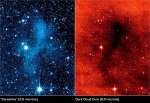 Coreshine from a Dark Cloud
30.09.2010
Stars and their planets are born in cold, dark, interstellar clouds of gas and dust. While exploring the clouds at infrared wavelengths, astronomers have made a surprising discovery -- dozens of cases where dense cloud cores shine by reflecting infrared starlight.
 WR 104: A Pinwheel Star System
3.06.2014
Might this giant pinwheel one-day destroy us? Probably not, but investigation of the unusual star system Wolf-Rayet 104 has turned up an unexpected threat. The unusual pinwheel pattern has been found to be created by energetic winds of gas and dust that are expelled and intertwine as two massive stars orbit each other.
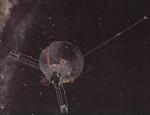 Pioneer 10: The First 7 Billion Miles
25.08.2001
Q: What was made by humans and is 7.3 billion miles away? A: Pioneer 10 -- and 1997 was the 25th anniversary of its launch. Almost 11 light-hours distant, Pioneer 10 is presently about twice as far from the Sun as Pluto, and bound for interstellar space at 28,000 miles per hour.
|
January February March April May June July August September |
|||||||||||||||||||||||||||||||||||||||||||||||||