
|
You entered: space
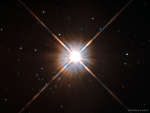 Proxima Centauri: The Closest Star
18.01.2016
Does the closest star to our Sun have planets? No one is sure -- but you can now follow frequent updates of a new search that is taking place during the first few months of this year. The closest star, Proxima Centauri, is the nearest member of the Alpha Centauri star system.
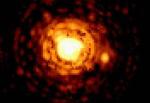 Small Star
20.11.1999
A dim double star system cataloged as Gliese 623 lies 25 light-years from Earth, in the constellation of Hercules. The individual stars of this binary system were distinguished for the first time when the Hubble Space Telescope's Faint Object Camera recorded this image in June 1994.
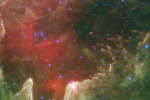 W5: Pillars of Star Creation
16.09.2008
How do stars form? A study of star forming region W5 by the orbiting Spitzer Space Telescope provides clear clues by recording that massive stars near the center of empty cavities are older than stars near the edges.
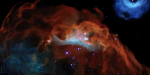 Journey into the Cosmic Reef
18.05.2020
What would you see if you could fly into the Cosmic Reef? The nebular cloud NGC 2014 appear to some like an ocean reef that resides in the sky, specifically in the LMC, the largest satellite galaxy of our Milky Way Galaxy.
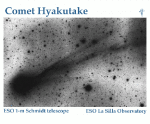 Here Comes Comet Hyakutake
13.03.1996
The reaction of ancient peoples to the appearance of bright comets has toppled empires, de-throned kings, and been taken as a sign of great things to come. Probably some of these comets did not get as bright as Comet Hyakutake ("hyah-koo-tah-kay") will in the next two weeks.
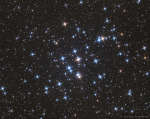 M44: The Beehive Cluster
30.04.2022
A mere 600 light-years away, M44 is one of the closest star clusters to our solar system. Also known as the Praesepe or the Beehive cluster its stars are young though, about 600 million years old compared to our Sun's 4.5 billion years.
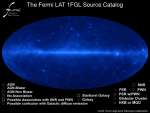 Fermi Catalogs the Gamma ray Sky
18.03.2010
What shines in the gamma-ray sky? The most complete answer yet to that question is offered by the Fermi Gamma-ray Space Telescope's first all-sky catalog. Fermi's sources of cosmic gamma-rays feature nature...
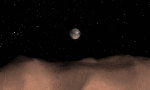 Earth Nears Asteroid Toutatis
20.01.1997
On November 29, 1996 the Earth came within 3.3 million miles of the asteroid Toutatis. Above is a computer simulated picture of this spectacle from the surface of Toutatis (a 2.5 degree field of view looking toward Earth). In Earth's sky, Toutatis appeared only as a faint object moving against a background of stars.
 LL Orionis: When Cosmic Winds Collide
15.11.2003
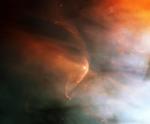
This arcing, graceful structure is actually a bow shock about half a light-year across, created as the wind from young star LL Orionis collides with the Orion Nebula flow. Adrift in Orion's stellar...
 Nearby Cepheid Variable RS Pup
9.09.2013
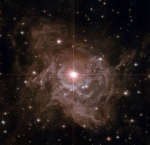
It is one of the most important stars in the sky. This is partly because, by coincidence, it is surrounded by a dazzling reflection nebula. Pulsating RS Puppis, the brightest star in the image center, is some ten times more massive than our Sun and on average 15,000 times more luminous.
|
January February March April May June July August September |
|||||||||||||||||||||||||||||||||||||||||||||||||