
|
You entered: Sun
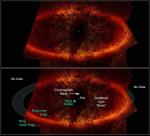 Ring Around Fomalhaut
1.07.2005
Fomalhaut (sounds like "foam-a-lot") is a bright, young, star, a mere 25 light-year trip from planet Earth in the direction of the constellation Piscis Austrinus. Earlier infrared observations identified a torus of cold material...
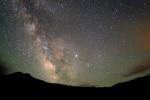 Jupiter, Vesta, and the Milky Way
25.05.2007
In this gorgeous skyscape, gas giant Jupiter along with the stars and cosmic dust clouds of the Milky Way hang over the southern horizon in the early morning hours as seen from Stagecoach, Colorado, USA. Recorded on Thursday, Jupiter is the brightest object near picture center.
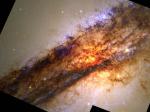 The Center of Centaurus A
29.07.2007
A fantastic jumble of young blue star clusters, gigantic glowing gas clouds, and imposing dark dust lanes surrounds the central region of the active galaxy Centaurus A. This mosaic of Hubble Space Telescope images taken in blue, green, and red light has been processed to present a natural color picture of this cosmic maelstrom.
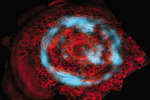 Unusual Auroras Over Saturns North Pole
19.11.2008
What's causing this unusual aurora over Saturn? No one is sure. Infrared images by the robotic Cassini spacecraft of the north pole of Saturn have uncovered aurora unlike any other seen previously in our Solar System.
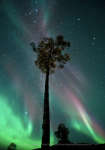 September Aurora
21.09.2012
September's equinox arrives tomorrow as the Sun crosses the celestial equator heading south. The event marks the astronomical beginning of spring in the southern hemisphere and autumn in the north. And though the connection is still puzzling, the equinox seasons bring an increase in geomagnetic storms.
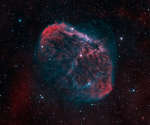 NGC 6888: The Crescent Nebula
10.06.2016
NGC 6888, also known as the Crescent Nebula, is a cosmic bubble about 25 light-years across, blown by winds from its central, bright, massive star. This sharp telescopic portrait uses narrow band image data that isolates light from hydrogen and oxygen atoms in the wind-blown nebula.
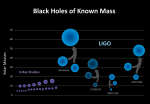 Black Holes of Known Mass
2.06.2017
Add GW170104 to the chart of black holes with known mass. The extremely energetic merger of two smaller black holes corresponds to the Laser Interferometer Gravitational-wave Observatory's (LIGO) third detection of gravitational waves.
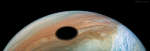 Io Eclipse Shadow on Jupiter from Juno
7.10.2019
What's that dark spot on Jupiter? It's the shadow of Jupiter's most volcanic moon Io. Since Jupiter shines predominantly by reflected sunlight, anything that blocks that light leaves a shadow. If you could somehow be in that shadow, you would see a total eclipse of the Sun by Io.
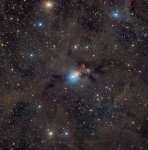 Stardust in the Perseus Molecular Cloud
18.03.2021
Clouds of stardust drift through this deep skyscape, across the Perseus molecular cloud some 850 light-years away. Dusty nebulae reflecting light from embedded young stars stand out in the nearly 2 degree wide telescopic field of view.
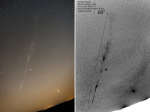 The Further Tail of Comet Leonard
30.12.2021
Comet Leonard, brightest comet of 2021, is at the lower left of these two panels captured on December 29 in dark Atacama desert skies. Heading for its perihelion on January 3 Comet Leonard's visible tail has grown.
|
January February March April May June July August |
||||||||||||||||||||||||||||||||||||||||||||||||||||||||