
|
You entered: Sun
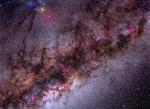 Our Galaxy in Stars, Gas, and Dust
27.09.1999
The disk of our Milky Way Galaxy is home to hot nebulae, cold dust, and billions of stars. The red nebulae visible in the above contrast-enhanced picture are primarily emission nebulae, glowing clouds of hydrogen gas heated by nearby, bright, young stars.
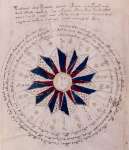 The Mysterious Voynich Manuscript
31.01.2010
The ancient text has no known title, no known author, and is written in no known language: what does it say and why does it have many astronomy illustrations? The mysterious book was once bought by an emperor, forgotten on a library shelf, sold for thousands of dollars, and later donated to Yale.
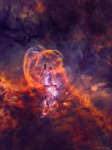 Star Forming Region NGC 3582 without Stars
30.07.2019
What's happening in the Statue of Liberty nebula? Bright stars and interesting molecules are forming and being liberated. The complex nebula resides in the star forming region called RCW 57, and besides the iconic monument, to some looks like a flying superhero or a weeping angel.
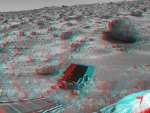 Yogi And Friends in 3D
22.08.2020
From July of 1997, a ramp from the Pathfinder lander, the Sojourner robot rover, airbags, a couch, Barnacle Bill and Yogi Rock appear together in this 3D stereo view of the surface of Mars. Barnacle Bill is the rock just left of the solar-paneled Sojourner. Yogi is the big friendly-looking boulder at top right.
 MAVEN s Ultraviolet Mars
27.06.2023
These two global views of Mars were captured at ultraviolet wavelengths, beyond the spectrum visible to human eyes. Recorded by the MAVEN spacecraft's Imaging Ultraviolet Spectrograph instrument in July 2022 (left) and January 2023, three otherwise invisible ultraviolet bands are mapped into red, green, and blue colors.
 APOD: 2023 December 27 Б Rainbow Aurora over Icelandic Waterfall
27.12.2023
Yes, but can your aurora do this? First, yes, auroras can look like rainbows even though they are completely different phenomena. Auroras are caused by Sun-created particles being channeled into Earth's atmosphere by Earth's magnetic field, and create colors by exciting atoms at different heights.
 Doomed Star Eta Carinae
13.08.2000
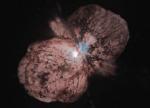
Eta Carinae may be about to explode. But no one knows when - it may be next year, it may be one million years from now. Eta Carinae's mass - about 100 times greater than our Sun - makes it an excellent candidate for a full blown su
 Pluto: New Horizons
18.10.2001
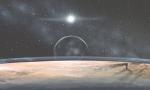
Pluto's horizon spans the foreground in this artist's vision, gazing sunward across that distant and still unexplored world. Titled New Horizons, the painting also depicts Pluto's companion, Charon, as a darkened, ghostly apparition with a luminous crescent against a starry background.
 Doomed Star Eta Carinae
28.04.2002
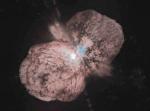
Eta Carinae may be about to explode. But no one knows when - it may be next year, it may be one million years from now. Eta Carinae's mass - about 100 times greater than our Sun - makes it an excellent candidate for a full blown supernova.
 Accretion Disk Simulation
12.03.2005
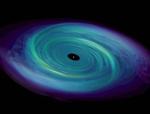
Don't be fooled by the familiar pattern. The graceful spiral structure seen in this computer visualization does not portray winding spiral arms in a distant galaxy of stars. Instead, the graphic shows spiral...
|
January February March April May June July August |
||||||||||||||||||||||||||||||||||||||||||||||||||||||||