
|
You entered: Sun
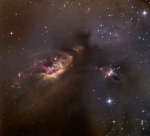 Sh2-239: Celestial Impasto
8.12.2011
The cosmic brush of star formation composed this alluring mix of dust and dark nebulae. Cataloged as Sh2-239 and LDN 1551, the region lies near the southern end of the Taurus molecular cloud complex some 450 light-years distant.
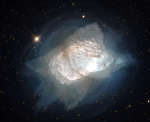 Bright Planetary Nebula NGC 7027 from Hubble
26.08.2013
It is one of the brightest planetary nebulae on the sky -- what should it be named? First discovered in 1878, nebula NGC 7027 can be seen toward the constellation of the Swan (Cygnus) with a standard backyard telescope.
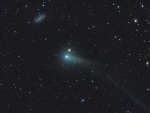 Comet PanSTARRS with Galaxy
6.06.2014
Sweeping slowly through northern skies, the comet PanSTARRS C/2012 K1 posed for this telescopic portrait on June 2nd in the constellation Ursa Major. Now in the inner solar system, the icy body from the Oort cloud sports two tails, a lighter broad dust tail and crooked ion tail extending below and right.
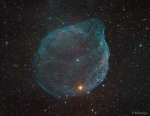 Sharpless 308: Star Bubble
22.06.2015
Blown by fast winds from a hot, massive star, this cosmic bubble is huge. Cataloged as Sharpless 2-308 it lies some 5,200 light-years away toward the constellation of the Big Dog (Canis Major) and covers slightly more of the sky than a Full Moon.
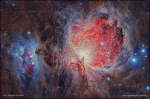 M42: The Great Orion Nebula
28.11.2017
Few astronomical sights excite the imagination like the nearby stellar nursery known as the Orion Nebula. The Nebula's glowing gas surrounds hot young stars at the edge of an immense interstellar molecular cloud.
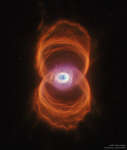 MyCn 18: The Engraved Hourglass Planetary Nebula
28.09.2019
Do you see the hourglass shape -- or does it see you? If you can picture it, the rings of MyCn 18 trace the outline of an hourglass -- although one with an unusual eye in its center. Either way, the sands of time are running out for the central star of this hourglass-shaped planetary nebula.
 APOD: 2025 March 10 Б NGC 1499: The California Nebula
9.03.2025
Could Queen Calafia's mythical island exist in space? Perhaps not, but by chance the outline of this molecular space cloud echoes the outline of the state of California, USA. Our Sun has its home within the Milky Way's Orion Arm, only about 1,000 light-years from the California Nebula.
 Tololo Totality
14.03.2025
On March 14 the Moon was Full. In an appropriate celebration of Pi day, that put the Moon 3.14 radians (180 degrees) in ecliptic longitude from the Sun in planet Earth's sky.
 APOD: 2026 August 13 Б Total Solar Eclipse Over Spain
12.08.2026
On August 12th, 2026, the Moon totally eclipsed the Sun and cast its shadow across Siberia, Greenland, Iceland, Spain, and Portugal. TodayБs image features two total solar eclipses viewed from Zaragoza, Spain, one over the Cathedral-Basilica of Our Lady of the Pillar and the other reflecting in the Ebro River.
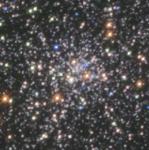 At The Core Of M15
16.01.1998
Densely packed stars in the core of the globular cluster M15 are shown in this Hubble Space Telescope (HST) image. The star colors roughly indicate their temperatures - hot stars appear blue, cooler stars look reddish-orange.
|
January February March April May June July August September |
|||||||||||||||||||||||||||||||||||||||||||||||||