
|
You entered: dark
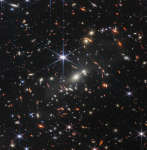 Webb s First Deep Field
13.07.2022
This is the deepest, sharpest infrared image of the cosmos so far. The view of the early Universe toward the southern constellation Volans was achieved in 12.5 hours of exposure with the NIRCam instrument on the James Webb Space Telescope. Of course the stars with six visible spikes are well within our own Milky Way.
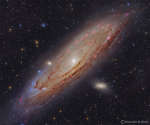 APOD: 2023 March 22 Б M31: The Andromeda Galaxy
22.03.2023
How far can you see? The most distant object easily visible to the unaided eye is M31, the great Andromeda Galaxy, over two million light-years away. Without a telescope, even this immense spiral galaxy appears as an unremarkable, faint, nebulous cloud in the constellation Andromeda.
 Galaxies in the River
27.07.2023
Large galaxies grow by eating small ones. Even our own galaxy engages in a sort of galactic cannibalism, absorbing small galaxies that are too close and are captured by the Milky Way's gravity.
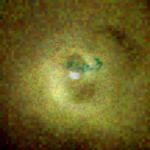 X-Rays From The Perseus Cluster Core
15.06.2000
The Perseus Cluster of thousands of galaxies, 320 million light-years distant, is one of the most massive objects in the Universe. At its core lies the giant cannibal galaxy Perseus A (NGC 1275), accreting matter as gas and galaxies fall into it.
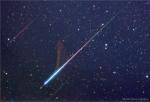 Fireball, Smoke Trail, Meteor Storm
22.11.2001
Returning from orbit, space shuttles enter the atmosphere at about 8 kilometers per second as friction heats their protective ceramic tiles to over 1,400 degrees Celsius. By contrast, the bits of comet dust...
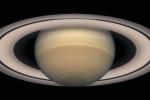 Saturn: Lord of the Rings
17.01.2004
Born in 1564, Galileo used a telescope to explore the Solar System. In 1610, he became the first to be amazed by Saturn's rings, After nearly 400 years, Saturn's magnificent rings still offer one of the most stunning astronomical sights.
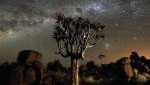 Namibian Nights
4.02.2013
Namibia has some of the darkest nights visible from any continent. It is therefore home to some of the more spectacular skyscapes, a few of which have been captured in the above time-lapse video.
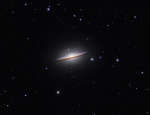 The Sombrero Galaxy from Hale
15.07.2013
What's going on in the center of this spiral galaxy? Named the Sombrero Galaxy for its hat-like resemblance, M104 features a prominent dust lane and a bright halo of stars and globular clusters.
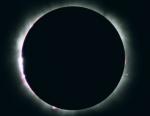 Total Eclipse of the Active Sun
20.06.2001
A total eclipse of the Sun is that special geocentric celestial event where the Moon passes exactly in front of the solar disk. During a fleeting few minutes of totality, fortunate earthdwellers located within...
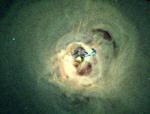 X Rays from the Perseus Cluster Core
8.12.2005
The Perseus Cluster of thousands of galaxies, 250 million light-years distant, is one of the most massive objects in the Universe and the brightest galaxy cluster in the x-ray sky. At its core lies the giant cannibal galaxy Perseus A (NGC 1275), accreting matter as gas and galaxies fall into it.
|
January February March April May June July August September |
|||||||||||||||||||||||||||||||||||||||||||||||||