
|
You entered: dark
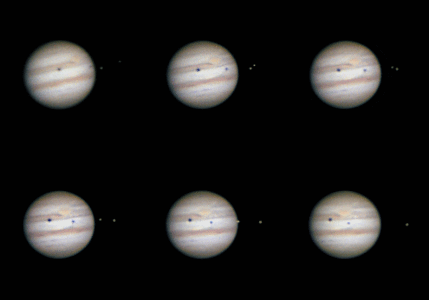 When Moons and Shadows Dance
26.02.2003
It's no wonder Jupiter is a favorite target for even modest earthbound telescopes. The most massive planet in the solar system with four of the largest moons also boasts the famous Great Red Spot, a giant hurricane-like storm system over three hundred years old.
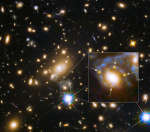 Galaxy and Cluster Create Four Images of Distant Supernova
8.03.2015
What are the unusual spots surrounding that galaxy? They are all images of the same supernova. For the first time, a single supernova explosion has been seen split into multiple images by the gravitational lens deflections of intervening masses. In this case the masses are a large galaxy and its home galaxy cluster.
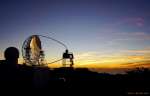 Cherenkov Telescope at Sunset
17.10.2018
On October 10, a new telescope reflected the light of the setting Sun. With dark horizon above and sunset colors below, its segmented mirror inverts an image of the beautiful evening sky in this snapshot from the Roque del Los Muchachos Observatory on the Canary Island of La Palma.
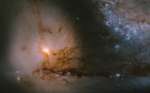 NGC 5195: The Dot under the Question Mark
31.08.2013
Dwarf galaxy NGC 5195 is best known as the smaller companion of spiral M51, the Whirlpool galaxy. Seen together they seem to trace the curve and dot of a cosmic question mark, recorded in Lord Rosse's 19th century drawings as one of the original spiral nebulae.
 Jupiters Clouds from New Horizons
25.06.2016
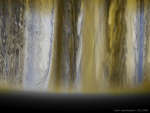
The New Horizons spacecraft took some stunning images of Jupiter on its way out to Pluto. Famous for its Great Red Spot, Jupiter is also known for its regular, equatorial cloud bands, visible through even modest sized telescopes.
 Jupiter in Ultraviolet from Hubble
15.10.2018
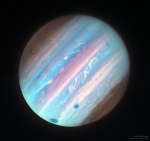
Jupiter looks a bit different in ultraviolet light. To better interpret Jupiter's cloud motions and to help NASA's robotic Juno spacecraft understand the planetary context of the small fields that it sees, the Hubble Space Telescope is being directed to regularly image the entire Jovian giant.
 Hyperion: Largest Known Galaxy Proto Supercluster
22.10.2018
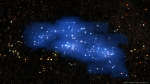
How did galaxies form in the early universe? To help find out, astronomers surveyed a patch of dark night sky with the Very Large Telescope array in Chile to find and count galaxies that formed when our universe was very young.
 APOD: 2026 September 8 Б Hubble: Decagon Around Saturns South Pole
7.09.2026
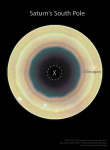
Why are SaturnБs poles geometric? SaturnБs North Pole has been known to be surrounded by a hexagonal (6 sides) cloud since discovery in 1987 in data taken by NASAБs Voyager spacecrafts, which quickly flew past the ringed world in the early 1980s.
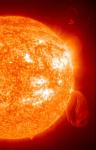 Maximum Sun
28.02.2001
Astronomers recently witnessed an astounding, large scale solar event as the Sun's north and south magnetic poles changed places! But, this complete solar magnetic field flip was actually anticipated. It occurs every 11 years during the maximum of the solar activity cycle.
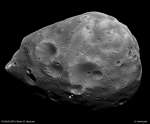 Phobos from Mars Express
16.03.2010
Why is this small object orbiting Mars? The origin of Phobos, the larger of the two moons orbiting Mars, remains unknown. Phobos and Deimos appear very similar to C-type asteroids, yet gravitationally capturing such asteroids, circularizing their orbits, and dragging them into Mars' equatorial plane seems unlikely.
|
January February March April May June July August September |
|||||||||||||||||||||||||||||||||||||||||||||||||