
|
You entered: dark
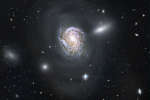 NGC 4911: Spiral Diving into a Dense Cluster
8.09.2010
Why are there faint rings around this spiral galaxy? Possibly because the galaxy, NGC 4911, is being pulled at by its neighbors as it falls into the enormous Coma Cluster of Galaxies.
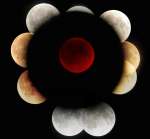 Lunar Eclipses
25.04.2013
The dark, inner shadow of planet Earth is called the umbra. Shaped like a cone extending into space, it has a circular cross section and is most easily seen during a lunar eclipse. But the complete cross section is larger than the Moon's angular size in the stages of an eclipse.
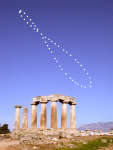 Apollo s Analemma
22.09.2013
Today, the Sun crosses the celestial equator heading south at 20:44 Universal Time. An equinox (equal night), this astronomical event marks the first day of autumn in the northern hemisphere and spring in the south.
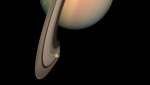 Cassini Approaches Saturn
11.09.2017
What would it look like to approach Saturn in a spaceship? One doesn't have to just imagine -- the Cassini spacecraft did just this in 2004, recording thousands of images along the way, and hundreds of thousands more since entering orbit.
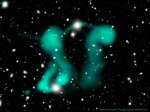 Dancing Ghosts: Curved Jets from Active Galaxies
1.09.2021
Why would galaxies emit jets that look like ghosts? And furthermore, why do they appear to be dancing? The curled and fluffy jets from the supermassive black holes at the centers of two host galaxies (top center and lower left) are unlike anything seen before.
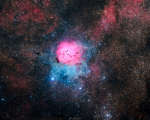 A Beautiful Trifid
5.08.2022
The beautiful Trifid Nebula is a cosmic study in contrasts. Also known as M20, it lies about 5,000 light-years away toward the nebula rich constellation Sagittarius. A star forming region in the plane...
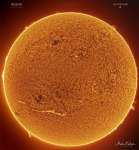 APOD: 2023 February 22 Б Our Increasingly Active Sun
22.02.2023
Our Sun is becoming a busy place. Only two years ago, the Sun was emerging from a solar minimum so quiet that months would go by without even a single sunspot. In contrast, already...
 APOD: 2024 May 24 Б M78 from the Euclid Space Telescope
24.05.2024
Star formation can be messy. To help find out just how messy, ESA's new Sun-orbiting Euclid telescope recently captured the most detailed image ever of the bright star forming region M78. Near...
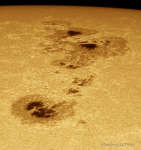 APOD: 2026 June 28 Б AR 4478: Giant Sunspot Group
28.06.2026
Right now, one of the largest sunspot groups in recent history is crossing the Sun. Active Region 4478 is not only big -- it's violent, showing tangled magnetic fields capable of throwing off huge clouds of particles into the Solar System. Some of these CMEs might impact the Earth.
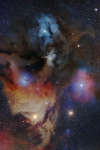 APOD: 2026 July 1 Б The Cotton Candy Clouds of Rho Ophiuchi
1.07.2026
Although they look like cotton candy, you cannot eat these clouds! Taken in Cádiz, Spain, today's image features the Rho Ophiuchi complex, a rich tapestry of young and old astronomical phenomena. This colorful cloud complex is a nearby star-forming region containing hundreds of young stellar objects, including protostars and T Tauri stars.
|
January February March April May June July August September |
|||||||||||||||||||||||||||||||||||||||||||||||||