
|
You entered: Earth
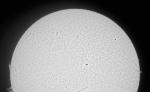 Mercury Transits the Sun
13.05.2003
How big is the Sun? The Sun is not only larger than any planet, it is larger than all of the planets put together. The Sun accounts for about 99.9 percent of all the mass in its Solar System.
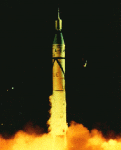 The First Explorer
18.05.1997
The first US spacecraft was Explorer 1. The cylindrical 30 pound satellite was launched (above) as the fourth stage of a Jupiter-C rocket (a modified US Army Redstone ballistic missile) and achieved orbit on January 31, 1958.
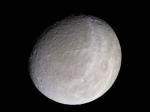 Saturns Moon Rhea from Cassini
15.02.2005
Each moon of Saturn seems to come with its own mystery. Rhea, Saturn's second largest moon behind Titan, shows unusual wisps, visible above as light colored streaks. Higher resolution images of the wisps show them to be made of long braided fractures.
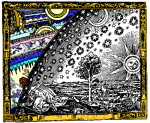 The Millennium that Defines Universe
1.01.2000
Welcome to the millennial year at the threshold of millennium three. During millennium two, humanity continually redefined its concept of "Universe": first as spheres centered on the Earth, in mid-millennium as the Solar System, a few centuries ago as the Galaxy, and within the last century as the matter emanating from the Big Bang.
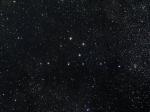 Collinder 399: The Coat Hanger
12.01.2007
Is this coat hanger a star cluster or an asterism? This cosmic hang-up has been debated over much of last century, as astronomers wondered whether this binocular-visible object is really a physically associated open cluster or a chance projection. Chance star projections are known as asterisms, an example of which is the popular Big Dipper.
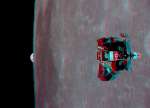 The Eagle Rises
25.07.2009
Get out your red/blue glasses and check out this remarkable stereo view from lunar orbit. Created from two photographs (AS11-44-6633, AS11-44-6634) taken by astronaut Michael Collins forty years ago during the 1969 Apollo...
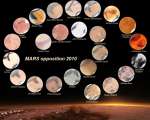 The Faces of Mars
5.05.2010
Enthusiastic astro-artists ranging from expert to beginner, the youngest age 10, all contributed their work to this entertaining panel featuring different faces of Mars. Their sketches are all based on telescopic views of the Red Planet from earlier this year, near its 2010 opposition.
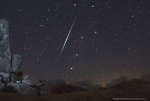 Meteor in the Desert Sky
11.12.2010
Created as planet Earth sweeps through dusty debris from mysterious, asteroid-like, 3200 Phaethon, the annual Geminid Meteor Shower should be the best meteor shower of the year. The Geminids are predicted to peak on the night of December 13/14, but you can start watching for Geminid meteors this weekend.
 NGC 3521 Close Up
13.01.2011
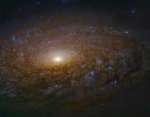
Gorgeous spiral galaxy NGC 3521 is a mere 35 million light-years distant, toward the constellation Leo. Spanning some 50,000 light-years, its central region is shown in this dramatic image, constructed from data drawn from the Hubble Legacy Archive.
 Mercury and Jupiter at Sunset
18.03.2011
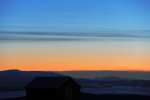
When warm sunset hues begin to fade, two celestial beacons now shine in the evening twilight, Mercury and Jupiter. Wandering away from the Sun in planet Earth's sky, Mercury will offer good views this month as spring approaches in the northern hemisphere where the ecliptic plane makes a steep angle with the western horizon.
|
January February |
|||||||||||||||||||||||||||||||||||||||||||||||||