
|
You entered: Earth
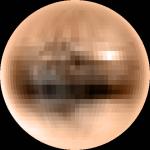 Pluto in True Color
18.03.2001
Pluto is mostly brown. The above picture captures the true colors of Pluto as well as the highest surface resolution so far recovered. No spacecraft has yet visited this most distant planet in our Solar System.
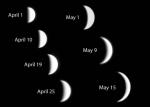 Phases of Venus
21.05.2004
Venus is currently falling out of the western evening sky. Second planet from the Sun and third brightest celestial object after the Sun and Moon, Venus has been appreciated by casual sky gazers as a brilliant beacon above the horizon after sunset. But telescopic images have also revealed its dramatic phases.
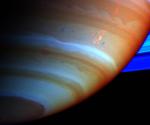 Saturn s Dragon Storm
24.02.2005
Dubbed the "Dragon Storm", convoluted, swirling cloud features are tinted orange in this false-color, near-infrared image of Saturn's southern hemisphere. In one of a series of discoveries announced by Cassini researchers, the Dragon...
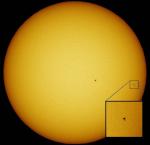 ISS and Discovery Transit the Sun
29.07.2005
That large sunspot near the right edge of the Sun is actually not a sunspot at all. It's the International Space Station (ISS) docked with the Space Shuttle Discovery on mission STS-114.
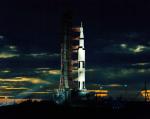 The Last Moon Shot
9.12.2005
In 1865 Jules Verne predicted the invention of a space capsule that could carry people. His science fiction story "From the Earth to the Moon" outlined his vision of a cannon in Florida so powerful that it could shoot a Projectile-Vehicle carrying three adventurers to the Moon.
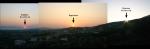 Sunrise by Season
20.12.2005
Does the Sun always rise in the same direction? No. As the seasons change, the direction toward the rising Sun will change, too. The Sun will always rise and set furthest to the south during the day of Winter Solstice, and furthest to the north during Summer Solstice.
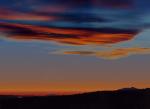 Mercury on the Horizon
19.03.2000
Have you ever seen the planet Mercury? Because Mercury orbits so close to the Sun, it is never seen far from the Sun, and so is only visible near sunrise or sunset. If trailing the Sun, Mercury will be visible for several minutes before it follows the Sun behind the Earth.
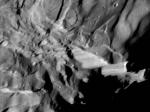 Verona Rupes: Tallest Known Cliff in the Solar System
23.07.2007
Could you survive a jump off the tallest cliff in the Solar System? Quite possibly. Verona Rupes on Uranus' moon Miranda is estimated to be 20 kilometers deep -- ten times the depth of the Earth's Grand Canyon.
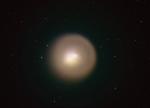 Golden Comet Holmes
2.11.2007
Surprising Comet Holmes remains easily visible as a round, fuzzy cloud in the northern constellation Perseus. Skywatchers with telescopes, binoculars, or those that just decide to look up can enjoy the solar system's latest prodigy as it glides about 150 million kilometers from Earth, beyond the orbit of Mars.
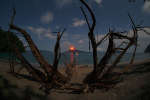 Erupting Volcano Anak Krakatau
13.07.2009
A volcano on Krakatoa is still erupting. Perhaps most famous for the powerfully explosive eruption in 1883 that killed tens of thousands of people, ash from a violent eruption might also have temporarily altered Earth's climate as long as 1500 years ago.
|
January February |
|||||||||||||||||||||||||||||||||||||||||||||||||