
|
You entered: Earth
 Ring of Fire over Monument Valley
5.10.2023
Tracking along a narrow path, the shadow of a new moon will race across North, Central, and South America, on October 14. When viewed from the shadow path the apparent size of the lunar disk will not quite completely cover the Sun though.
 APOD: 2024 December 2 Б NGC 300: A Galaxy of Stars
2.12.2024
This galaxy is unusual for how many stars it seems that you can see. Stars are so abundantly evident in this deep exposure of the spiral galaxy NGC 300 because so many of these stars are bright blue and grouped into resolvable bright star clusters.
 Comet G3 ATLAS: a Tail and a Telescope
24.01.2025
Comet C/2024 G3 ATLAS has made a dramatic appearance in planet Earth's skies. A visitor from the distant Oort Cloud, the comet reached its perihelion on January 13. On January 19, the bright comet was captured here from ESO Paranal Observatory in the Atacama desert in Chile.
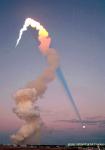 Shuttle Plume Shadow Points to Moon
19.02.2001
Why would the shadow of a space shuttle launch plume point toward the Moon? Two weeks ago during the launch of Atlantis, the Sun, Earth, Moon, and rocket were all properly aligned for this photogenic coincidence.
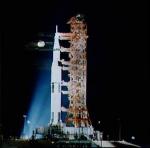 The Last Moon Shot
17.06.2000
In 1865 Jules Verne predicted the invention of a space capsule that could carry people. In his science fiction story "From the Earth to the Moon", he outlined his vision of a cannon in Florida so powerful that it could shoot a "Projectile-Vehicle" carrying three adventurers to the Moon.
 Dione's Lagrange Moon Helene
10.10.1995
Saturn's moon Helene is very unusual in that it circles Saturn near the orbit of a bigger moon: Dione. Helene is situated in what is called a "Lagrange point" of Dione - a place of stability created by Dione's gravity.
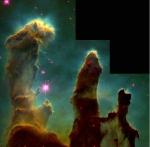 From Eagle's EGGs A Star Is Born
19.01.1997
Perhaps the most famous astronomical image in recent years reveals newborn stars upon pillars of gas and dust - uncovered as researchers used the Hubble Space Telescope to explore the Eagle Nebula in 1995. This...
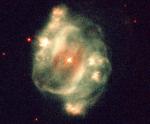 NGC 5307: A Symmetric Planetary Nebula
31.12.1997
Some stellar nebulae are strangely symmetric. For example, every major blob of gas visible on the upper left of NGC 5307 appears to have a counterpart on the lower right. This picture taken by the Hubble Space Telescope was released last week. NGC 5307 is an example of a planetary nebula with a spiral shape.
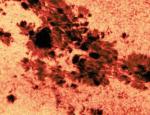 Sunspots: Magnetic Depressions
22.03.1998
Our Sun has spots! These spots appear dark in photographs like the one above, but in fact sunspots are quite bright - they are just dark compared to the rest of the Sun. Sunspots are about the size of the Earth and frequently occur in groups, as shown above.
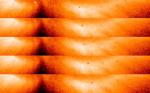 X-ray Transit of Mercury
2.07.1998
This sequence of false color X-ray images captures a rare event - the passage or transit of planet Mercury in front of the Sun. Mercury's small disk is silhouetted against the bright background of X-rays from the hot Solar Corona.
|
January February March April May June July August September October |
|||||||||||||||||||||||||||||||||||||||||||||||||