
|
You entered: Earth
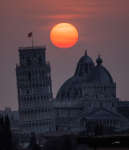 Leaning Tower, Active Sun
1.04.2022
The natural filter of a hazy atmosphere offered this recognizable architecture and sunset view on March 27. Dark against the solar disk, large sunspots in solar active regions 2975 and 2976 are wedged between the Duomo of Pisa and its famous Leaning Tower.
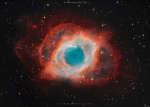 NGC 7293: The Helix Nebula
7.12.2022
A mere seven hundred light years from Earth, toward the constellation Aquarius, a sun-like star is dying. The dying star's last few thousand years have produced the Helix Nebula (NGC 7293), a well studied and nearby example of a Planetary Nebula, typical of this final phase of stellar evolution.
 APOD: 2023 August 23 Б The Meteor and the Galaxy
23.08.2023
It came from outer space. It -- in this case a sand-sized bit of a comet nucleus -- was likely ejected many years ago from Sun-orbiting Comet Swift-Tuttle, but then continued to orbit the Sun alone.
 APOD: 2023 September 5 Б Blue Supermoon Beyond Syracuse
5.09.2023
The last full moon was doubly unusual. First of all, it was a blue moon. A modern definition of a blue moon is a second full moon to occur during one calendar month. Since there are 13 full moons in 2023, one month has to have two -- and that month was August.
 Northern Lights, West Virginia
12.10.2024
A gravel country lane gently winds through this colorful rural night skyscape. Captured from Monroe County in southern West Virginia on the evening of October 10, the starry sky above is a familiar sight. Shimmering curtains of aurora borealis or northern lights definitely do not make regular appearances here, though.
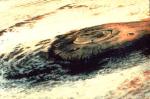 Olympus Mons on Mars: The Largest Volcano
15.09.1997
The largest volcano in the Solar System is on Mars. Olympus Mons rises 24 kilometers high and measures 550 km across. By comparison, Earth's largest volcano, Mauna Loa in Hawaii, rises 9 km high and measures 120 km across.
 A Star Where Photons Orbit
26.11.1995
The above computer animated picture depicts how a very compact star would look to a nearby observer. The star pictured is actually more compact that any known except a black hole, so it is only hypothetical. The observer is situated at the photon sphere, where photons can orbit in a circle.
 Shuttle Engine Blast
1.01.1996
The Space Shuttle Discovery's orbital maneuvering system (OMS) engine firing produced this dramatic flare as it cruised "upside down" in low Earth orbit. Discovery was named for a ship commanded by Captain James Cook RN, the 18th Century English astronomer and navigator.
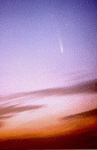 The Sun Sets on Comet Hyakutake
28.04.1996
Comet Hyakutake is seen here just as the Sun sets on April 22. As April draws to a close, Comet Hyakutake will be visible only just after sunset and will be hard to discern against the brightly lit sky.
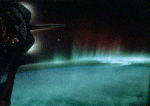 Southern Lights and Shuttle Glow
6.05.1996
A background of distant stars, sinuous and spiky bands of Southern Lights (Aurora Australis), and the faint glow of charged plasma (ionized atomic gas) surrounding the Space Shuttle Discovery's engines give this photo from the STS-39 mission an eerie, otherworldly look.
|
January February |
|||||||||||||||||||||||||||||||||||||||||||||||||