
|
You entered: background
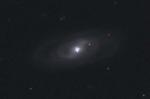 The Einstein Cross Gravitational Lens
10.10.2000
Most galaxies have a single nucleus -- does this galaxy have four? The strange answer leads astronomers to conclude that the nucleus of the surrounding galaxy is not even visible in this image. The central cloverleaf is rather light emitted from a background quasar.
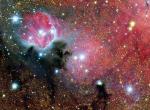 East of the Lagoon Nebula
20.05.2002
To the east of the Lagoon Nebula is a star field rich in diversity. On the lower left are clouds rich in dark dust that hide background stars and young star systems still forming. Dark clouds include LDN 227 on the left and IC 1275 on the right, with a bright star near its tip.
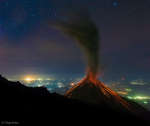 Volcano of Fire Erupts Under the Stars
10.03.2015
First, there was an unusual smell. Then there was a loud bang. But what appeared to the eye was the most amazing of all. While waiting near midnight to see a possible eruption of VolcАn de Fuego (Volcano of Fire) in Guatemala last month, a ready camera captured this extraordinary image.
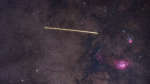 55 Nights with Saturn
28.09.2018
For 55 consecutive nights Mediterranean skies were at least partly clear this summer, from the 1st of July to the 24th of August 2018. An exposure from each night was incorporated in this composited telephoto and telescopic image to follow bright planet Saturn as it wandered through the generous evening skies.
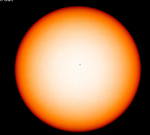 Mercury Crosses a Quiet Sun
1.12.2019
What's that black dot crossing the Sun? The planet Mercury. Mercury usually passes over or under the Sun, as seen from Earth, but last month the Solar System's innermost planet appeared to go just about straight across the middle.
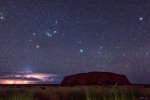 Lightning and Orion Beyond Uluru
10.05.2021
What's happening behind Uluru? A United Nations World Heritage Site, Uluru is an extraordinary 350-meter high mountain in central Australia that rises sharply from nearly flat surroundings. Composed of sandstone, Uluru has slowly formed over the past 300 million years as softer rock eroded away.
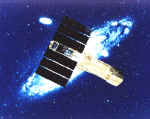 ASCA X-Ray Observatory
19.02.1996
Today marks the third anniversary of the launch of the Advanced Satellite for Cosmology and Astrophysics (ASCA; renamed from Astro D when launched). ASCA, seen here superposed on galaxy M31, is a Japanese satellite for which NASA has provided some scientific equipment. ASCA carries four large-area X-ray telescopes.
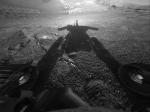 Shadow of a Martian Robot
3.08.2004
What if you saw your shadow on Mars and it wasn't human? Then you might be the Opportunity rover currently exploring Mars. Opportunity and sister robot Spirit have been probing the red planet since January, finding evidence of ancient water, and sending breathtaking images across the inner Solar System.
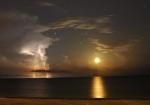 Moon Lightning
7.10.2004
Moonsets are not often quite as exciting as this one. But amateur astronomer Marc-Andre Besel was impressed by the brilliant lighting displays that joined the first quarter Moon and stars of the constellation Scorpius in western skies.
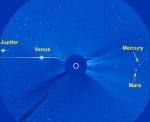 Children of the Sun
15.11.2006
For a moment, planets Jupiter, Venus, Mars, and Mercury all posed near their parent star in this Sun-centered view, recorded on November 11. The picture, from a coronograph onboard the space-based SOlar Heliospheric Observatory, spans 15 degrees with the Sun's size and position indicated by the white circle.
|
January February March April May June July August |
||||||||||||||||||||||||||||||||||||||||||||||||||||||||