
|
You entered: background
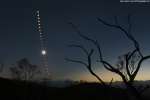 Moon Shadow Sequence
16.11.2012
On the morning of November 14, the Moon's umbral shadow tracked across northern Australia before heading into the southern Pacific. Captured from a hilltop some 30 miles west of the outback town of Mount Carbine, Queensland, a series of exposures follows the progress of the total solar eclipse in this dramatic composite image.
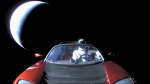 Roadster, Starman, Planet Earth
9.02.2018
Don't panic. It's just a spacesuited mannequin named Starman. As the sunlit crescent of planet Earth recedes in the background, Starman is comfortably seated at the wheel of a Tesla Roadster in this final image of the payload launched by a Falcon Heavy rocket on February 6.
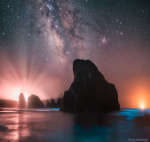 Sea and Sky Glows over the Oregon Coast
27.08.2018
Every step caused the sand to light up blue. That glow was bioluminescence -- a blue radiance that also lights the surf in this surreal scene captured last month at Meyer's Creek Beach in Oregon, USA. Volcanic stacks dot the foreground sea, while a thin fog layer scatters light on the horizon.
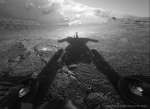 APOD: 2026 February 22 Б Shadow of a Martian Robot
21.02.2026
What if you saw your shadow on Mars and it wasn't human? Then you might be the Opportunity rover exploring Mars. Opportunity explored the Red Planet from 2004 to 2018, finding evidence of ancient water, and sending breathtaking images across the inner Solar System.
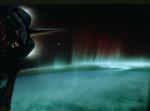 Southern Lights and Shuttle Glow
21.02.1998
A background of distant stars, sinuous and spiky bands of Southern Lights (Aurora Australis), and the faint glow of charged plasma (ionized atomic gas) surrounding the Space Shuttle Discovery's engines give this photo from the STS-39 mission an eerie, otherworldly look.
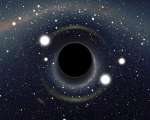 Too Close to a Black Hole
6.12.2010
What would you see if you went right up to a black hole? Above is a computer generated image highlighting how strange things would look. The black hole has such strong gravity that light is noticeably bent towards it - causing some very unusual visual distortions.
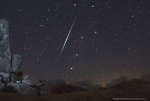 Meteor in the Desert Sky
10.12.2010
Created as planet Earth sweeps through dusty debris from mysterious, asteroid-like, 3200 Phaethon, the annual Geminid Meteor Shower should be the best meteor shower of the year. The Geminids are predicted to peak on the night of December 13/14, but you can start watching for Geminid meteors this weekend.
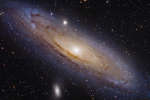 M31: The Andromeda Galaxy
26.06.2013
Andromeda is the nearest major galaxy to our own Milky Way Galaxy. Our Galaxy is thought to look much like Andromeda. Together these two galaxies dominate the Local Group of galaxies. The diffuse light from Andromeda is caused by the hundreds of billions of stars that compose it.
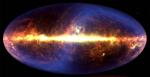 The Infrared Sky
27.01.1998
Three major sources contribute to the far-infrared sky: our Solar System, our Galaxy, and our Universe. The above image, in representative colors, is a projection of the entire infrared sky created from years of observations by the robot spacecraft COBE.
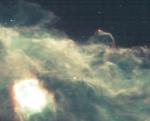 Infrared Horsehead
6.08.1998
This famous cosmic dust cloud was imaged in infrared light by the European Space Agency's Infrared Space Observatory (ISO) satellite. The false-color picture shows the bright infrared emission from dust and molecular gas in part of the Orion star forming region surrounding the Horsehead Nebula.
|
January February March April May June July August |
||||||||||||||||||||||||||||||||||||||||||||||||||||||||