
|
You entered: background
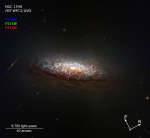 Hubble s NGC 1546
21.06.2024
Returning to science operations on June 14, the Hubble Space Telescope used its new pointing mode to capture this sharp image of spiral galaxy NGC 1546. A member of the Dorado galaxy group, the island universe lies a mere 50 million light-years away.
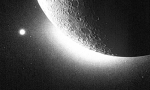 Sunshine, Earthshine at the Lunar Limb
30.05.1996
This dramatic image of the Moon's edge against a background of distant stars is from a perspective impossible for groundbased telescopes. It was taken by a star tracker camera onboard the Clementine spacecraft.
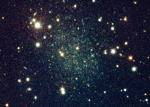 Antlia: A New Galactic Neighbor
23.04.1997
Meet Antlia, a newly discovered neighbor of our Milky Way Galaxy. Announced just last week, this faint member of our Local Group of Galaxies has only about one million stars. It is late in being noticed because it is so hard to see against a bright sky.
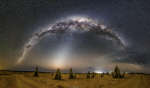 Milky Way and Zodiacal Light over Australian Pinnacles
10.10.2017
What strange world is this? Earth. In the foreground of the featured image are the Pinnacles, unusual rock spires in Nambung National Park in Western Australia. Made of ancient sea shells (limestone), how these human-sized picturesque spires formed remains a topic of research. The panorama was taken last month.
 Comet 13P Olbers
28.06.2024
Not a paradox, Comet 13P/Olbers is returning to the inner Solar System after 68 years. The periodic, Halley-type comet will reach its next perihelion or closest approach to the Sun on June 30 and has become a target for binocular viewing low in planet Earth's northern hemisphere night skies.
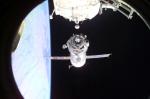 Leaving the International Space Station
17.12.2001
It was time to go home. During their eight days aboard the Earth-orbiting International Space Station (ISS), ESA Flight Engineer Claudie Haigner, Russian Commander Victor Afanasyev, and Russian Flight Engineer Konstantin Kozeev had completed several experiments and successfully delivered a new lifeboat.
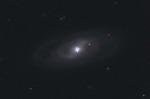 The Einstein Cross Gravitational Lens
27.03.2005
Most galaxies have a single nucleus -- does this galaxy have four? The strange answer leads astronomers to conclude that the nucleus of the surrounding galaxy is not even visible in this image. The central cloverleaf is rather light emitted from a background quasar.
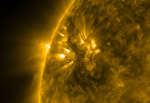 Dark Filament of the Sun
22.05.2010
Suspended by magnetic fields above a solar active region this dark filament stretches over 40 earth-diameters. The ominous structure appears to be frozen in time near the Sun's edge, but solar filaments are unstable and often erupt.
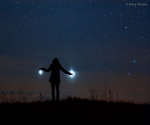 Jupiter and Venus from Earth
25.10.2015
It was visible around the world. The sunset conjunction of Jupiter and Venus in 2012 was visible almost no matter where you lived on Earth. Anyone on the planet with a clear western horizon at sunset could see them.
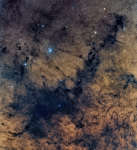 The Pipe Nebula
7.08.2020
East of Antares, dark markings sprawl through crowded star fields toward the center of our Milky Way Galaxy. Cataloged in the early 20th century by astronomer E. E. Barnard, the obscuring interstellar dust clouds include B59, B72, B77 and B78, seen in against the starry background.
|
January February March April May June July August |
||||||||||||||||||||||||||||||||||||||||||||||||||||||||