
|
You entered: Earth
 APOD: 2025 December 24 Б Mystery: Little Red Dots in the Early Universe
24.12.2025
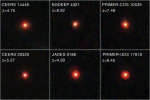
What are these little red dots (LRDs)? Nobody knows. Discovered only last year, hundreds of LRDs have now been found by the James Webb Space Telescope in the early universe. Although extremely faint, LRDs are now frequently identified in deep observations made for other purposes.
 The Early Universe
14.06.1997
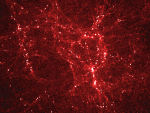
What did our universe look like when it was young? To answer this, cosmologists run sophisticated computer programs tracking the locations of millions of particles. The above animated frame is the result of such a calculation and shows how our universe might have looked when it was just a fracton of its current age.
 Earth at Night
13.02.2022
This is what the Earth looks like at night. Can you find your favorite country or city? Surprisingly, city lights make this task quite possible. Human-made lights highlight particularly developed or populated areas of the Earth's surface, including the seaboards of Europe, the eastern United States, and Japan.
 Blue Marble Earth
6.02.2022
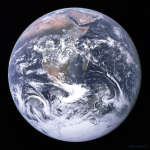
Welcome to planet Earth, the third planet from a star named the Sun. The Earth is shaped like a sphere and composed mostly of rock. Over 70 percent of the Earth's surface is water. The planet has a relatively thin atmosphere composed mostly of nitrogen and oxygen.
 The Early Universe
16.02.1996
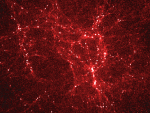
What did our universe look like when it was young? To answer this, cosmologists run sophisticated computer programs tracking the locations of millions of particles. The above animated frame is the result of such a calculation and shows how our universe might have looked when it was just a fracton of its current age.
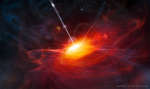 Illustration: An Early Quasar
22.02.2022
What did the first quasars look like? The nearest quasars are now known to involve supermassive black holes in the centers of active galaxies. Gas and dust that falls toward a quasar glows brightly, sometimes outglowing the entire home galaxy.
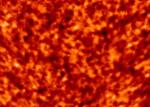 BOOMERANG Images The Early Universe
3.05.2000
Drifting through the stratosphere above Antarctica in late 1998, the balloon-borne BOOMERANG telescope peered into the cosmos at millimeter wavelengths. The blotchy structures it detected are seen above in the sharpest yet picture of the universe at an early age, perhaps a mere 300,000 years old.
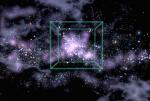 Unexpected Galaxy String in the Early Universe
20.01.2004
How could such a long string of galaxies form so early in the universe? Several new measurements of galaxies and clusters in the early universe are reporting structures involving galaxies and clusters that are larger than expected with the new standard "dark-energy" cosmology.
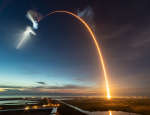 Dawn s Early Light, Rocket s Red Glare
4.07.2018
If you saw the dawn's early light from Cape Canaveral Air Force Station last Friday, June 29, then you could have seen this rocket's red glare. The single 277-second long exposure, made...
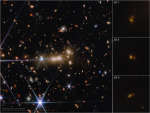 APOD: 2023 January 18 Б MACS0647: Gravitational Lensing of the Early Universe by Webb
18.01.2023
Gravitational lensing by the galaxy cluster MACS0647 -- in which the massive foreground cluster distorts and lenses the light emitted by distant background galaxies along the line of sight Б is on vivid display here in this recent multi-color infrared image from the James Webb Space Telescope (JWST).
|
January February March April May June July August September October |
|||||||||||||||||||||||||||||||||||||||||||||||||