
|
You entered: Earth
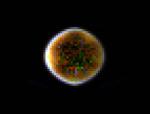 Gamma Ray Earth
31.03.2005
The pixelated planet above is actually our own planet Earth seen in gamma rays - the most energetic form of light. In fact, the gamma rays used to construct this view pack over 35 million electron volts (MeV) compared to a mere two electron volts (eV) for a typical visible light photon.
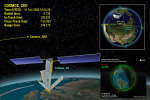 Satellites Collide in Low Earth Orbit
18.02.2009
How often do satellites collide? Although minuscule space debris may strike any satellite on occasion, the first known collision between time two full satellites occurred only last week. Even though thousands of satellites have been launched, the low collision rate is caused by the great vastness of space.
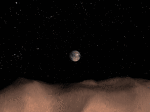 Earth Nears Asteroid Toutatis
1.10.2004
On Wednesday, September 29, the Earth came within one million miles of the asteroid Toutatis -- the closest predicted aproach of our fair planet to a sizable asteroid or comet in this century. Coming within...
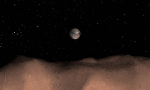 Earth Nears Asteroid Toutatis
20.01.1997
On November 29, 1996 the Earth came within 3.3 million miles of the asteroid Toutatis. Above is a computer simulated picture of this spectacle from the surface of Toutatis (a 2.5 degree field of view looking toward Earth). In Earth's sky, Toutatis appeared only as a faint object moving against a background of stars.
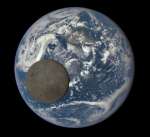 Full Earth, Full Moon
7.08.2015
The Moon was new on July 16. Its familiar nearside facing the surface of planet Earth was in shadow. But on that date a million miles away, the Deep Space Climate Observatory (DSCOVR) spacecraft's Earth Polychromatic Imaging Camera (EPIC) captured this view of an apparently Full Moon crossing in front of a Full Earth.
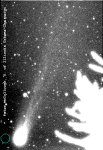 Comet Hyakutake Passes the Earth
25.03.1996
This picture of Comet Hyakutake taken the night of March 21/22 in Illinois, USA shows the enormous tail that has already developed. The silhouette on the right is a foreground tree, and the superposed green circle on the left shows the size of the full moon.
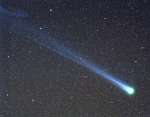 Comet Hyakutake Passes the Earth
16.12.2009
In 1996, an unexpectedly bright comet passed by planet Earth. Discovered less than two months before, Comet C/1996 B2 Hyakutake came within only 1/10th of the Earth-Sun distance from the Earth in late March.
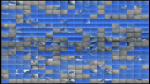 A Year of Sky on Earth
24.07.2013
Each panel shows one day. With 360 movie panels, the sky over (almost) an entire year is shown in time lapse format as recorded by a video camera on the roof of the Exploratorium museum in San Francisco, California.
 Combined Solar Eclipse Corona from Earth and Space
12.04.2016
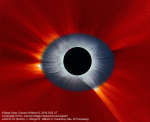
Sometimes, a total eclipse is a good time to eye the Sun. Taking advantage of an unusual juxtaposition of Earth, Moon and Sun, the featured image depicts the total solar eclipse that occurred last month as it appeared -- nearly simultaneously -- from both Earth and space.
 Gamma Ray Earth and Sky
6.12.2013
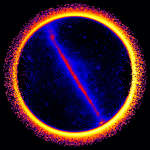
For an Earth-orbiting gamma-ray telescope, Earth is actually the brightest source of gamma-rays, the most energetic form of light. Gamma-rays from Earth are produced when high energy particles, cosmic rays from space, crash into the atmosphere.
|
January February March April May June July August September October |
|||||||||||||||||||||||||||||||||||||||||||||||||