
|
You entered: Sun
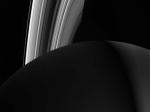 Saturn at Night
12.09.2006
This is what Saturn looks like at night. In contrast to the human-made lights that cause the nighttime side of Earth to glow faintly, Saturn's faint nighttime glow is primarily caused by sunlight reflecting off of its own majestic rings.
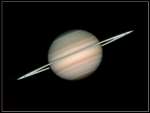 Saturn in View
4.03.2009
Very good telescopic views of Saturn can be expected in the coming days as the ringed planet nears opposition on March 8th, its closest approach to Earth in 2009. Of course, opposition means opposite the Sun in planet Earth's sky - an arrangement that occurs almost yearly for Saturn.
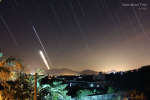 A Fading Moonset Over Hong Kong
15.12.2009
Do stars appear dimmer when nearer the horizon? Yes -- atmospheric air absorbs and reradiates light, so that the greater the airmass through which one peers, the fainter an object will appear. Pictured above in a multi-frame image, stars, the planet Jupiter, and even the Moon show the horizon-dimming effects of Earth's nearly-transparent atmosphere.
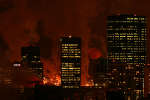 Red Snow Moon over Edmonton
28.02.2011
What's hovering between those buildings? The Moon. The above image was taken two weeks ago as the full Snow Moon started to rise above Edmonton, Alberta, Canada. The odd coincidence between the angular size of the far distant Moon and the angular width of nearby buildings created a striking juxtaposition.
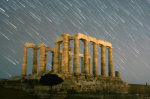 Celestial Trails over Greece
4.05.2011
If you watch the horizon at just the right place and at just the right time, you can witness some spectacular juxtapositions between Earth and sky. In the above video, stars, the Moon, and even a partially eclipsed Sun were recorded rising and setting over photogenic landmarks in Greece.
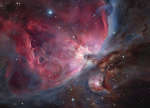 At the Heart of Orion
1.01.2015
Near the center of this sharp cosmic portrait, at the heart of the Orion Nebula, are four hot, massive stars known as the Trapezium. Tightly gathered within a region about 1.5 light-years in radius, they dominate the core of the dense Orion Nebula Star Cluster.
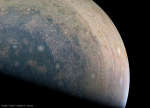 Cloud Swirls around Southern Jupiter from Juno
13.02.2017
Juno just completed its fourth pass near Jupiter. Launched from Earth in 2011 and arriving at Jupiter just last July, robotic Juno concluded its latest elliptical orbit around our Solar System's largest planet 11 days ago.
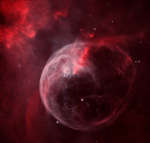 NGC 7635: The Bubble Nebula
19.04.2018
Blown by the wind from a massive star, this interstellar apparition has a surprisingly familiar shape. Cataloged as NGC 7635, it is also known simply as The Bubble Nebula. Although it looks delicate, the 7 light-year diameter bubble offers evidence of violent processes at work.
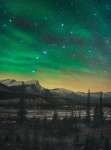 Airglow Borealis
27.10.2018
The best known asterism in northern skies hangs over the Canadian Rockies in this mountain and night skyscape taken last week from Banff National Park. But most remarkable is the amazing greenish airglow. With...
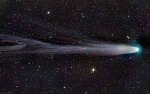 The Tail of a Christmas Comet
25.12.2021
The tail of a comet streams across this three degree wide telescopic field of view captured under dark Namibian skies on December 21. In outburst only a few days ago and just reaching naked eye visibility Comet Leonard (C/2021 A1) is this year's brightest comet.
|
January February March April May June July August |
||||||||||||||||||||||||||||||||||||||||||||||||||||||||