
|
You entered: Sun
 Halo of the Cats Eye
1.06.2014
The Cat's Eye Nebula (NGC 6543) is one of the best known planetary nebulae in the sky. Its haunting symmetries are seen in the very central region of this stunning false-color picture, processed...
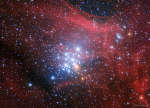 NGC 3293: A Bright Young Star Cluster
6.04.2015
Hot blue stars shine brightly in this beautiful, recently formed galactic or "open" star cluster. Open cluster NGC 3293 is located in the constellation Carina, lies at a distance of about 8000 light years, and has a particularly high abundance of these young bright stars.
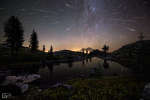 Perseid Meteors over Mount Shasta
8.08.2016
Where are all of these meteors coming from? In terms of direction on the sky, the pointed answer is the constellation of Perseus. That is why the meteor shower that peaks later this week is known as the Perseids -- the meteors all appear to came from a radiant toward Perseus.
 Halo of the Cats Eye
7.06.2020
The Cat's Eye Nebula (NGC 6543) is one of the best known planetary nebulae in the sky. Its haunting symmetries are seen in the very central region of this stunning false-color picture, processed...
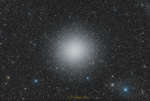 Globular Cluster Omega Centauri
11.07.2024
Globular star cluster Omega Centauri packs about 10 million stars much older than the Sun into a volume some 150 light-years in diameter. Also known as NGC 5139, at a distance...
 APOD: 2024 September 30 Б Comet Tsuchinshan ATLAS over Mexico
30.09.2024
The new comet has passed its closest to the Sun and is now moving closer to the Earth. C/2023 A3 (TsuchinshanБATLAS) is currently moving out from inside the orbit of Venus and on track to pass its nearest to the Earth in about two weeks.
 APOD: 2024 October 13 Б Aurora Timelapse Over Italian Alps
13.10.2024
Did you see last night's aurora? This question was relevant around much of the world a few days ago because a powerful auroral storm became visible unusually far from the Earth's poles.
 APOD: 2024 October 21 Б Comet Tsuchinshan ATLAS over California
21.10.2024
The tails of Comet Tsuchinshan-ATLAS were a sight to behold. Pictured, C/2023 A3 (TsuchinshanБATLAS) was captured near peak impressiveness last week over the Eastern Sierra Mountains in California, USA. The comet not only showed a bright tail, but a distinct anti-tail pointing in nearly the opposite direction.
 Natural Saturn On The Cassini Cruise
29.01.2000
What could you see approaching Saturn aboard an interplanetary cruise ship? Your view would likely resemble this subtly shaded image of the gorgeous ringed gas giant. Processed by the Hubble Heritage project, the picture...
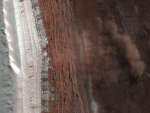 An Avalanche on Mars
11.03.2008
What caused this sudden cloud of dust on Mars? An avalanche! The first avalanche imaged in progress on another planet was recorded last month on Mars by NASA's robotic Mars Reconnaissance Orbiter. Visible...
|
January February March April May June July August |
||||||||||||||||||||||||||||||||||||||||||||||||||||||||