
|
You entered: Sun
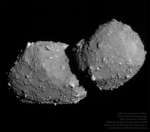 APOD: 2026 July 14 Б Double Lobed Asteroid Torifune
14.07.2026
Why is this asteroid a double? Earlier this month the Japanese robotic spacecraft Hayabusa2 shot past asteroid 98943 Torifune and captured pictures. Although previous observations from distant Earth indicated that Torifune was oblong, Hayabusa2 found that Torifune actually has two joined lobes.
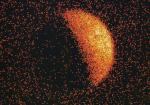 X Ray Moon
14.09.2002
This x-ray image of the Moon was made by the orbiting ROSAT (Röntgensatellit) Observatory in 1990. In this digital picture, pixel brightness corresponds to x-ray intensity. Consider the image in three parts: the bright hemisphere of the x-ray moon, the darker half of the moon, and the x-ray sky background.
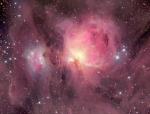 M42: Wisps of the Orion Nebula
25.02.2003
The Great Nebula in Orion, an immense, nearby starbirth region, is probably the most famous of all astronomical nebulas. Here, glowing gas surrounds hot young stars at the edge of an immense interstellar molecular cloud only 1500 light-years away. In the above deep image, faint wisps and sheets of dust and gas are particularly evident.
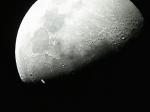 International Space Station in Transit
9.05.2003
A stunning telescopic image of the International Space Station crossing in front of an eight day old Moon, this picture was captured on April 11th. But while Wednesday's leisurely transit of Mercury across the Sun entertained observers all over the dayside of planet Earth, the audience for this lunar transit was more restricted.
 Eyeful of Saturn
30.04.2004
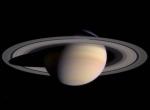
Now a bright speck of light wandering through Earth's night sky, magnificent planet Saturn lies nearly 1.5 billion kilometers from the Sun. But after an interplanetary voyage of seven years the planet's stunning rings nearly fill the field of the Cassini spacecraft's narrow angle camera in this image recorded on March 27.
 2003 UB 313: A Tenth Planet?
1.08.2005
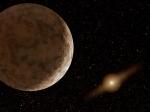
Has a tenth planet been discovered? A newly discovered object, designated 2003 UB 313 and located more than twice the distance of Pluto, is expected to be at least as large as Pluto and probably larger, given current measurements.
 The Center of Centaurus A
22.08.1999
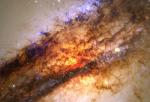
A fantastic jumble of young blue star clusters, gigantic glowing gas clouds, and imposing dark dust lanes surrounds the central region of the active galaxy Centaurus A. This mosaic of Hubble Space Telescope images taken in blue, green, and red light has been processed to present a natural color picture of this cosmic maelstrom.
 Sharpless 308
23.04.2009
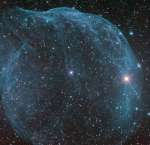
Blown by fast winds from a hot, massive star, this cosmic bubble is huge. Cataloged as Sharpless 308 it lies some 5,200 light-years away in the constellation Canis Major and covers over 2/3 degree on the sky (compared with 1/2 degree for the Full Moon).
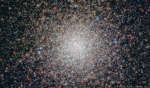 Star Cluster NGC 362 from Hubble
11.10.2017
If our Sun were near the center of NGC 362, the night sky would glow like a jewel box of bright stars. Hundreds of stars would glow brighter than Sirius, and in many different colors.
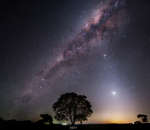 A Light and Dusty Night
2.10.2021
Posing as a brilliant evening star, Venus lies near the western horizon in this southern hemisphere, early spring, night skyscape. To create the composite view exposures tracking the sky and fixed for the foreground were taken on September 25 from Cascavel in southern Brazil.
|
January February March April May June July August |
||||||||||||||||||||||||||||||||||||||||||||||||||||||||