
|
You entered: telescope
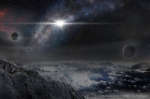 A Candidate for the Biggest Boom Yet Seen
26.01.2016
It is a candidate for the brightest and most powerful explosion ever seen -- what is it? The flaring spot of light was found by the All Sky Automated Survey for Supernovae (ASASSN) in June of last year and labelled ASASSN-15lh.
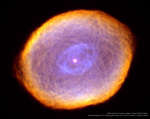 IC 418: The Spirograph Nebula
11.06.2017
What is creating the strange texture of IC 418? Dubbed the Spirograph Nebula for its resemblance to drawings from a cyclical drawing tool, planetary nebula IC 418 shows patterns that are not well understood. Perhaps they are related to chaotic winds from the variable central star, which changes brightness unpredictably in just a few hours.
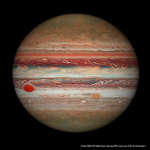 Hubbles Jupiter and the Shrinking Great Red Spot
25.04.2018
What will become of Jupiter's Great Red Spot? Gas giant Jupiter is the solar system's largest world with about 320 times the mass of planet Earth. Jupiter is home to one of the largest and longest lasting storm systems known, the Great Red Spot (GRS), visible to the left.
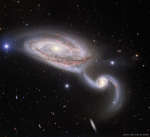 The Slow Dance of Galaxies NGC 5394 and 5395
4.03.2020
If you like slow dances, then this may be one for you. A single turn in this dance takes several hundred million years. Two galaxies, NGC 5394 and NGC 5395, slowly whirl about each other in a gravitational interaction that sets off a flourish of sparks in the form of new stars.
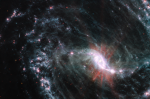 Barred Spiral Galaxy NGC 1365 from Webb
18.02.2023
A mere 56 million light-years distant toward the southern constellation Fornax, NGC 1365 is an enormous barred spiral galaxy about 200,000 light-years in diameter. That's twice the size of our own barred spiral Milky Way.
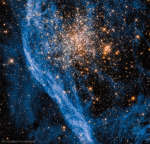 APOD: 2023 February 20 Б NGC 1850: Not Found in the Milky Way
20.02.2023
There is nothing like this ball of stars in our Milky Way Galaxy. This is surprising because, at first glance, this featured image by the Hubble Space Telescope suggests that star cluster NGC 1850...
 Unwinding M51
6.04.2024
The arms of a grand design spiral galaxy 60,000 light-years across are unwound in this digital transformation of the magnificent 2005 Hubble Space Telescope portrait of M51. In fact...
 Barred Spiral Galaxy NGC 1365 from Webb
13.11.2024
A mere 56 million light-years distant toward the southern constellation Fornax, NGC 1365 is an enormous barred spiral galaxy about 200,000 light-years in diameter. That's twice the size of our own barred spiral Milky Way.
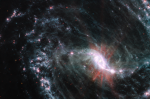 Barred Spiral Galaxy NGC 1365 from Webb
21.01.2026
A mere 56 million light-years distant toward the southern constellation Fornax, NGC 1365 is an enormous barred spiral galaxy about 200,000 light-years in diameter. That's twice the size of our own barred spiral Milky Way.
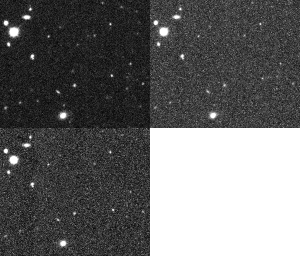 2012 VP113: A New Furthest Known Object in Solar System
31.03.2014
What is the furthest known object in our Solar System? The new answer is 2012 VP113, an object currently over twice the distance of Pluto from the Sun. Pictured above is a series...
|
January February March April May June July August September |
|||||||||||||||||||||||||||||||||||||||||||||||||