
|
You entered: telescope
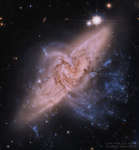 NGC 3314: When Galaxies Overlap
17.11.2021
Why doesn't the nearby galaxy create a gravitational lensing effect on the background galaxy? It does, but since both galaxies are so nearby, the angular shift is much smaller than the angular sizes of the galaxies themselves.
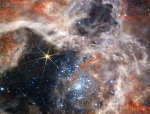 Tarantula Stars R136 from Webb
7.09.2022
Near the center of a nearby star-forming region lies a massive cluster containing some of the largest and hottest stars known. Collectively known as star cluster NGC 2070, these stars are part of the vast Tarantula Nebula and were captured in two kinds of infrared light by the new Webb Space Telescope.
 Supernova Remnant Cassiopeia A
17.01.2025
Massive stars in our Milky Way Galaxy live spectacular lives. Collapsing from vast cosmic clouds, their nuclear furnaces ignite and create heavy elements in their cores. After only a few million years for the most massive stars, the enriched material is blasted back into interstellar space where star formation can begin anew.
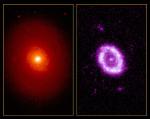 M94: Beyond the Blue
13.06.2001
Today's galaxy, M94 (NGC 4736), lies 15 million light-years away in the constellation Canes Venatici. In the red light image (left), its very bright nucleus and tightly wound spiral arms seem to slowly fade into a faint outer disk.
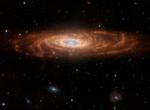 NGC 7331: A Galaxy So Inclined
1.07.2004
If our own Milky Way galaxy were 50 million light-years away with its disk inclined slightly to our line of sight, it would look a lot like large spiral galaxy NGC 7331. In fact...
 Supernova Survivor
10.09.2005
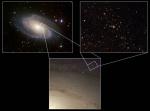
Beginning with a full view of beautiful spiral galaxy M81, follow the insets (left, bottom, then right) to zoom in on a real survivor. Seen at the center of the final field on the right is a star identified as the survivor of a cosmic cataclysm -- the supernova explosion of its companion star.
 Cat s Eye Hubble Remix
22.03.2008
Staring across interstellar space, the alluring Cat's Eye Nebula lies three thousand light-years from Earth. One of the most famous planetary nebulae in the sky, the Cat's Eye (NGC 6543) is over half a light-year across and represents a final, brief yet glorious phase in the life of a sun-like star.
 M27: Not a Comet
1.09.2011
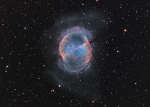
While hunting for comets in the skies above 18th century France, astronomer Charles Messier diligently kept a list of the things he encountered that were definitely not comets. This is number 27 on his now famous not-a-comet list.
 HD 163296: Jet from a Star in Formation
22.06.2021
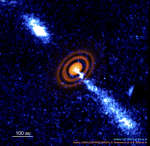
How are jets created during star formation? No one is sure, although recent images of the young star system HD 163296 are quite illuminating. The central star in the featured image is still forming but seen already surrounded by a rotating disk and an outward moving jet.
 Supernova Remnant Cassiopeia A
6.02.2026
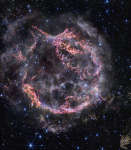
Massive stars in our Milky Way Galaxy live spectacular lives. Collapsing from vast cosmic clouds, their nuclear furnaces ignite and create heavy elements in their cores. After only a few million years for the most massive stars, the enriched material is blasted back into interstellar space where star formation can begin anew.
|
January February March April May June July August September |
|||||||||||||||||||||||||||||||||||||||||||||||||