
|
You entered: telescope
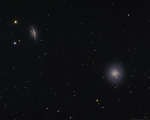 Cetus Galaxies and Supernova
6.12.2018
Large spiral galaxy NGC 1055 at top left joins spiral Messier 77 (bottom right) in this cosmic view toward the aquatic constellation Cetus. The narrowed, dusty appearance of edge-on spiral NGC 1055 contrasts nicely with the face-on view of M77's bright nucleus and spiral arms.
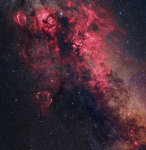 Cygnus Skyscape
25.07.2019
In brush strokes of interstellar dust and glowing hydrogen gas, this beautiful skyscape is painted across the plane of our Milky Way Galaxy near the northern end of the Great Rift and the constellation Cygnus the Swan.
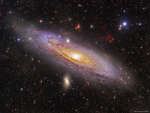 M31: The Andromeda Galaxy
9.09.2019
How far can you see? The most distant object easily visible to the unaided eye is M31, the great Andromeda Galaxy, over two million light-years away. Without a telescope, even this immense spiral galaxy appears as an unremarkable, faint, nebulous cloud in the constellation Andromeda.
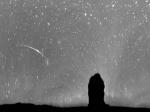 A Taurid Meteor Fireball
15.11.2005
Have you ever seen a very bright meteor? Unexpected, this year's Taurid meteor shower resulted in numerous reports of very bright fireballs during the nights surrounding Halloween. Pictured above, a fireball that momentarily rivaled the brightness of the full Moon was caught over Cerro Pachon, Chile by a continuous sky monitor on November 1.
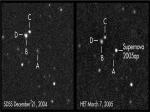 SN 2005ap: The Brightest Supernova Yet Found
16.10.2007
What could cause a bang this big? This supernova explosion was so inherently bright that it could be seen nearby 5 billion light years away (a redshift of 0.28) even with a small telescope.
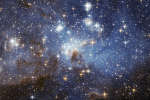 Star Forming Region LH 95
12.03.2008
How do stars form? To better understand this complex and chaotic process, astronomers used the Hubble Space Telescope to image in unprecedented detail the star forming region LH 95 in the nearby Large Magellanic Cloud galaxy.
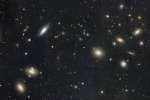 Inside the Coma Cluster of Galaxies
16.06.2008
Almost every object in the above photograph is a galaxy. The Coma Cluster of Galaxies pictured above is one of the densest clusters known - it contains thousands of galaxies. Each of these galaxies houses billions of stars - just as our own Milky Way Galaxy does.
 Comet and Orion
2.10.2009
These colorful panels both feature a familiar northern hemisphere astronomical sight: the stellar nursery known as the Great Orion Nebula. They also offer an intriguing and unfamiliar detail of the nebula rich skyscape -- a passing comet.
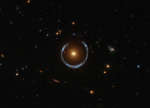 A Horseshoe Einstein Ring from Hubble
21.12.2011
What's large and blue and can wrap itself around an entire galaxy? A gravitational lens mirage. Pictured above, the gravity of a luminous red galaxy (LRG) has gravitationally distorted the light from a much more distant blue galaxy.
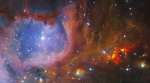 Messier 43
10.07.2015
Often imaged but rarely mentioned, Messier 43 is a large star forming region in its own right. It's just part of the star forming complex of gas and dust that includes the larger, more famous neighboring Messier 42, the Great Orion Nebula.
|
January February March April May June July August September |
|||||||||||||||||||||||||||||||||||||||||||||||||