
|
You entered: galaxies
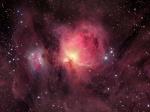 M42: Wisps of the Orion Nebula
18.09.2005
The Great Nebula in Orion, an immense, nearby starbirth region, is probably the most famous of all astronomical nebulas. Here, glowing gas surrounds hot young stars at the edge of an immense interstellar molecular cloud only 1500 light-years away. In the above deep image, faint wisps and sheets of dust and gas are particularly evident.
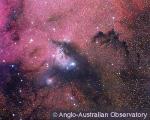 Reflections on NGC 6188
25.08.1999
NGC 6188 is an interstellar carnival of young blue stars, hot red gas, and cool dark dust. Located 4000 light years away in the disk of our Galaxy, NGC 6188 is home to the Ara OB1 association, a group of bright young stars whose nucleus forms the open cluster NGC 6193.
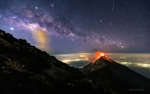 A Volcano of Fire under a Milky Way of Stars
27.05.2019
Sometimes it's hard to decide which is more impressive -- the land or the sky. On the land of the featured image, for example, the Volcano of Fire (VolcАn de Fuego) is seen erupting topped by red-hot, wind-blown ash and with streams of glowing lava running down its side.
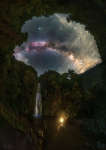 A Waterfall and the Milky Way
1.11.2021
The dream was to capture both the waterfall and the Milky Way together. Difficulties included finding a good camera location, artificially illuminating the waterfall and the surrounding valley effectively, capturing the entire scene with...
 APOD: 2023 July 17 Б Shells and Arcs around Star CW Leonis
17.07.2023
What's happening around this star? No one is sure. CW Leonis is the closest carbon star, a star that appears orange because of atmospheric carbon dispersed from interior nuclear fusion. But CW Leonis also appears engulfed in a gaseous carbon-rich nebula.
 APOD: 2025 April 20 Б The Orion Nebula in Visible and Infrared
20.04.2025
The Great Nebula in Orion is a colorful place. Visible to the unaided eye, it appears as a small fuzzy patch in the constellation of Orion. Long exposure, multi-wavelength images like this, however, show the Orion Nebula to be a busy neighborhood of young stars, hot gas, and dark dust.
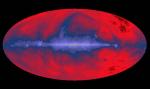 The Radio Sky: Tuned to 408MHz
20.10.2001
Tune your radio telescope to 408MHz (408 million cycles per second) and check out the Radio Sky! You should find that frequency on your dial somewhere between US broadcast television channels 13 and 14.
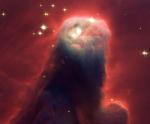 Cone Nebula Close Up
3.05.2002
Cones, pillars, and majestic flowing shapes abound in stellar nurseries where natal clouds of gas and dust are buffeted by energetic winds from newborn stars. A well-known example, the Cone Nebula within the bright galactic star-forming region NGC 2264, was captured in this close-up view from the Hubble Space Telescope's newest camera.
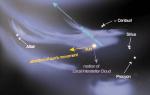 The Local Interstellar Cloud
11.04.2000
The stars are not alone. In the disk of our Milky Way Galaxy about 10 percent of visible matter is in the form of gas, called the interstellar medium (ISM). The ISM is not uniform, and shows patchiness even near our Sun.
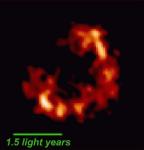 Supernova Remnant In M82
16.12.1999
This false-color radio wavelength picture of an expanding stellar debris cloud is the product of one of the largest radio astronomy experiments ever. Combining the output of 20 radio telescopes scattered around planet Earth...
|
January February March April May |
|||||||||||||||||||||||||||||||||||||||||||||||||