
|
You entered: galaxies
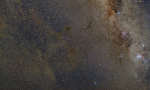 Sigma Octantis and Friends
28.06.2018
South pole star Sigma Octantis (of the constellation Octans) is on the left of this starry expanse spanning over 40 degrees across far southern skies. You'll have to look hard to find it, though.
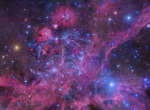 Vela Supernova Remnant Mosaic
10.01.2019
The plane of our Milky Way Galaxy runs through this complex and beautiful skyscape. Seen toward colorful stars near the northwestern edge of the constellation Vela (the Sails), the 16 degree wide, 200 frame...
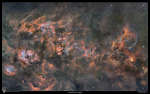 Cygnus Mosaic 2010 2020
11.02.2021
In brush strokes of interstellar dust and glowing gas, this beautiful skyscape is painted across the plane of our Milky Way Galaxy near the northern end of the Great Rift and the constellation Cygnus the Swan.
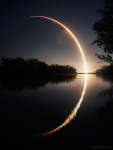 Launch of the IXPE Observatory
22.12.2021
Birds don't fly this high. Airplanes don't go this fast. The Statue of Liberty weighs less. No species other than human can even comprehend what is going on, nor could any human just a millennium ago. The launch of a rocket bound for space is an event that inspires awe and challenges description.
 Mu Cephei
12.10.2023
Mu Cephei is a very large star. An M-class supergiant some 1500 times the size of the Sun, it is one of the largest stars visible to the unaided eye, and even one of the largest in the entire Galaxy.
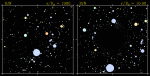 Too Close to a Black Hole
10.12.2000
What would you see if you went right up to a black hole? Above are two computer generated images highlighting how strange things would look. On the left is a normal star field containing the constellation Orion. Notice the three stars of nearly equal brightness that make up Orion's Belt.
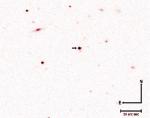 Is Mystery Object an Orphan Afterglow
12.11.2001
What is that unusual object? Astronomers can identify most objects that are imaged on the sky, but not all. Pictured above is one that currently defies classification. Attributes of the object include that it has unusual colors, appears to be fading as months go by, and appears to be associated with a distant galaxy.
 Explosions Discovered Near Galactic Center
28.02.1996
Tremendous explosions near the center of our Galaxy were discovered just this past December and are being announced today by a paper in Nature and a press conference at NASA. Bursts like these have...
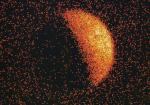 X Ray Moon
14.09.2002
This x-ray image of the Moon was made by the orbiting ROSAT (Röntgensatellit) Observatory in 1990. In this digital picture, pixel brightness corresponds to x-ray intensity. Consider the image in three parts: the bright hemisphere of the x-ray moon, the darker half of the moon, and the x-ray sky background.
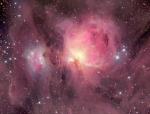 M42: Wisps of the Orion Nebula
25.02.2003
The Great Nebula in Orion, an immense, nearby starbirth region, is probably the most famous of all astronomical nebulas. Here, glowing gas surrounds hot young stars at the edge of an immense interstellar molecular cloud only 1500 light-years away. In the above deep image, faint wisps and sheets of dust and gas are particularly evident.
|
January February March April May |
|||||||||||||||||||||||||||||||||||||||||||||||||