
|
You entered: rotation
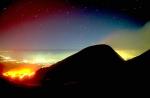 Mt Etna Lava Plumes
31.03.2003
Mt. Etna has been erupting for hundreds of thousands of years. Located in Sicily, Italy, the volcano produces lava fountains over one kilometer high. Mt. Etna is not only one of the most active...
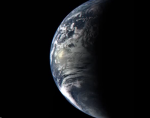 Leaving Earth
5.08.2013
What it would look like to leave planet Earth? Such an event was recorded visually in great detail by the MESSENGER spacecraft as it swung back past the Earth, eight years ago, on its way in toward the planet Mercury. Earth can be seen rotating in this time-lapse video, as it recedes into the distance.
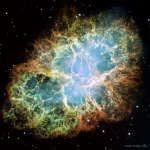 M1: The Crab Nebula from Hubble
16.08.2015
This is the mess that is left when a star explodes. The Crab Nebula, the result of a supernova seen in mysterious filaments. The filaments are not only tremendously complex, but appear to have less mass than expelled in the original supernova and a higher speed than expected from a free explosion.
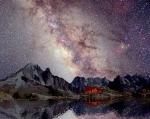 The Milky Way Over Mount Blanc
23.09.2002
Have you ever seen the band of our Milky Way Galaxy? Chances are you have never seen it like this -- nor could you. In a clear sky from a dark location at the right time, a faint band of light is visible across the sky. This band is the disk of our spiral galaxy.
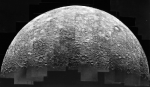 Mercury: A Cratered Inferno
12.09.1996
Mercury's surface looks similar to our Moon's. Each is heavily cratered and made of rock. Mercury's diameter is about 4800 km, while the Moon's is slightly less at about 3500 km (compared with about 12,700 km for the Earth). But Mercury is unique in many ways.
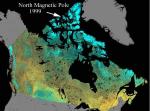 Earth's North Magnetic Pole
19.10.1999
A magnetic compass does not point toward the true North Pole of the Earth. Rather, it more closely points toward the North Magnetic Pole of the Earth. The North Magnetic Pole is currently located in northern Canada.
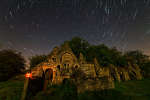 Ghosts and Star Trails
31.10.2015
Don't be scared. Stars won't fall from the sky and ghosts won't really haunt your neighborhood tonight. But it looks like they might be doing just that in this eerie picture of an eccentric old abandoned house in moonlight.
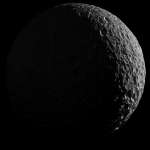 Mimas in Saturnlight
16.03.2017
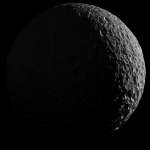
Peering from the shadows, the Saturn-facing hemisphere of Mimas lies in near darkness alongside a dramatic sunlit crescent. The mosaic was captured near the Cassini spacecraft's final close approach on January 30, 2017. Cassini's camera was pointed in a nearly sunward direction only 45,000 kilometers from Mimas.
 Mimas in Saturnlight
3.08.2019
Peering from the shadows, the Saturn-facing hemisphere of Mimas lies in near darkness alongside a dramatic sunlit crescent. The mosaic was captured near the Cassini spacecraft's final close approach on January 30, 2017. Cassini's camera was pointed in a nearly sunward direction only 45,000 kilometers from Mimas.
 Mimas in Saturnlight
30.07.2021
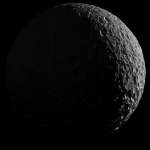
Peering from the shadows, the Saturn-facing hemisphere of Mimas lies in near darkness alongside a dramatic sunlit crescent. The mosaic was captured near the Cassini spacecraft's final close approach on January 30, 2017. Cassini's camera was pointed in a nearly sunward direction only 45,000 kilometers from Mimas.
|
January February March April May June July August |
||||||||||||||||||||||||||||||||||||||||||||||||||||||||