
|
You entered: rings
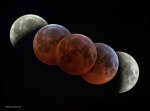 The Umbra of Earth
26.01.2019
The dark, inner shadow of planet Earth is called the umbra. Shaped like a cone extending into space, it has a circular cross section most easily seen during a lunar eclipse. For example...
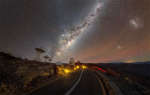 A Road to the Stars
15.03.2022
Pictured -- a very scenic road to the stars. The road approaches La Silla Observatory in Chile, with the ESO's 3.6-meter telescope just up ahead. To the left are some futuristic-looking support structures...
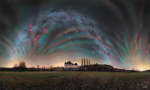 APOD: 2023 February 15 Б Airglow Sky over France
15.02.2023
This unusual sky was both familiar and unfamiliar. The photographer's mission was to capture the arch of the familiar central band of our Milky Way Galaxy over a picturesque medieval manor. The surprise was that on this January evening, the foreground sky was found glowing in a beautiful but unfamiliar manner.
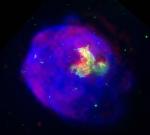 Structure in N63A
1.01.2004
Shells and arcs abound in this false-color, multiwavelength view of supernova remnant N63A, the debris of a massive stellar explosion. The x-ray emission (blue), is from gas heated to 10 million degrees C as knots of fast moving material from the cosmic blast sweep up surrounding interstellar matter.
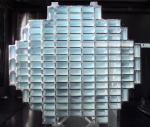 Aerogel For Stardust
18.02.1999
On February 7th, this honey comb of aluminum cells filled with aerogel was launched on the STARDUST mission to interplanetary space. STARDUST's goal is to capture dust from a comet's tail and return to planet Earth - the first sample return mission to a comet!
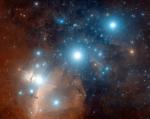 Alnitak, Alnilam, Mintaka
13.10.2005
Alnitak, Alnilam, and Mintaka, are the bright bluish stars from east to west (left to right) along the diagonal in this gorgeous cosmic vista. Otherwise known as the Belt of Orion, these three blue supergiant stars are hotter and much more massive than the Sun.
 Alnitak, Alnilam, Mintaka
29.12.2006
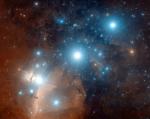
Alnitak, Alnilam, and Mintaka, are the bright bluish stars from east to west (left to right) along the diagonal in this gorgeous cosmic vista. Otherwise known as the Belt of Orion, these three blue supergiant stars are hotter and much more massive than the Sun.
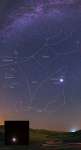 Opposite the Sun
18.09.2010
Chances are the brightest star you've seen lately is actually planet Jupiter. Jupiter rules the sky in this labeled view of a starry September night from the Alborz mountains in Iran, complete with the trail of a red flashlight illuminating the mountain road.
 Saturn Storm Panoramas
8.07.2011
These tantalizing panoramas follow a remarkable giant storm encircling the northern hemisphere of ringed planet Saturn. Still active, the roiling storm clouds were captured in near-infrared images recorded by the Cassini spacecraft on February 26 and stitched into the high resolution, false-color mosaics.
 Gale Crater
29.07.2011
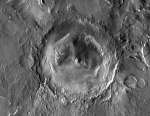
This sharp view from the Thermal Emission Imaging System camera on NASA's Mars Odyssey orbiter is centered on 154 kilometer (96 mile) wide Gale crater, near the martian equator. Within Gale, an impressive layered mountain rises about 5 kilometers (3 miles) above the crater floor.
|
January February March April May |
|||||||||||||||||||||||||||||||||||||||||||||||||