
|
You entered: rings
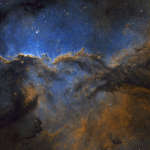 NGC 6188: The Dragons of Ara
6.11.2018
Dark shapes with bright edges winging their way through dusty NGC 6188 are tens of light-years long. The emission nebula is found near the edge of an otherwise dark large molecular cloud in the southern constellation Ara, about 4,000 light-years away.
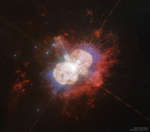 Doomed Star Eta Carinae
19.02.2019
Eta Carinae may be about to explode. But no one knows when - it may be next year, it may be one million years from now. Eta Carinae's mass - about 100 times greater than our Sun - makes it an excellent candidate for a full blown supernova.
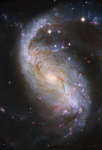 NGC 1672: Barred Spiral Galaxy from Hubble
5.04.2020
Many spiral galaxies have bars across their centers. Even our own Milky Way Galaxy is thought to have a modest central bar. Prominently barred spiral galaxy NGC 1672, featured here, was captured in spectacular detail in an image taken by the orbiting Hubble Space Telescope.
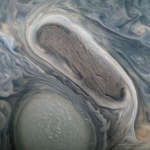 Giant Storms and High Clouds on Jupiter
28.12.2021
What and where are these large ovals? They are rotating storm clouds on Jupiter imaged last month by NASA's Juno spacecraft. In general, higher clouds are lighter in color, and the lightest clouds visible are the relatively small clouds that dot the lower oval.
 APOD: 2025 March 18 Б LDN 1235: The Shark Nebula
17.03.2025
There is no sea on Earth large enough to contain the Shark nebula. This predator apparition poses us no danger as it is composed only of interstellar gas and dust. Dark dust like that featured here is somewhat like cigarette smoke and created in the cool atmospheres of giant stars.
 APOD: 2025 July 26 Б Globular Cluster Omega Centauri
25.07.2025
Globular star cluster Omega Centauri packs about 10 million stars much older than the Sun into a volume some 150 light-years in diameter. Also known as NGC 5139, at a distance...
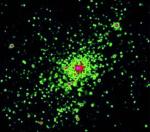 NGC 3603: X-Rays From A Starburst Cluster
23.01.2001
A mere 20,000 light-years from the Sun lies the NGC 3603 star cluster, a resident of the nearby Carina spiral arm of our Milky Way galaxy. Seen here in this recent false-color x-ray...
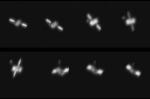 Compton Returns
6.03.2001
On 2000 June 4, the 17-ton Compton Gamma-Ray Observatory returned to Earth after 9 years in orbit -- ending its remarkable voyage of discovery. The massive, bus-sized spacecraft carried an unprecedented array of gamma-ray detectors which explored the bizarre, high-energy universe of solar flares, black holes, pulsars, supernovae, active galaxies, and gamma-ray bursts.
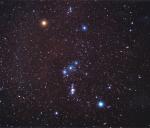 Orion on Film
6.02.2003
Orion, the Hunter, is one of the most easily recognizable constellations in planet Earth's night sky. But Orion's stars and nebulae don't look quite as colorful to the eye as they do in this lovely photograph, taken last month from Vekol Ranch south of Phoenix, Arizona, USA.
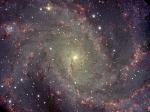 NGC 6946: The Fireworks Galaxy
24.01.2005
Why is this galaxy so active? Nearby spiral galaxy NGC 6946 is undergoing a tremendous burst of star formation with no obvious cause. In many cases spirals light up when interacting with another galaxy, but NGC 6946 appears relatively isolated in space.
|
January February March April May |
|||||||||||||||||||||||||||||||||||||||||||||||||