
|
You entered: rings
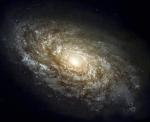 NGC 4414: A Telling Spiral
9.06.1999
How far away is this galaxy? Cosmologists the world over have been working hard to find out. Spiral galaxy NGC 4414 contains many Cepheid variable stars that oscillate in a way that allows astronomers to estimate their distance.
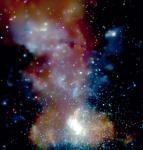 Galactic Center Star Clusters
10.08.2006
If you had x-ray vision, the central regions of our Galaxy would not be hidden from view by cosmic dust clouds. Instead, the Milky Way toward Sagittarius might look something like this. Pleasing...
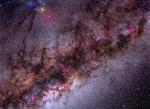 Our Galaxy in Stars, Gas, and Dust
27.09.1999
The disk of our Milky Way Galaxy is home to hot nebulae, cold dust, and billions of stars. The red nebulae visible in the above contrast-enhanced picture are primarily emission nebulae, glowing clouds of hydrogen gas heated by nearby, bright, young stars.
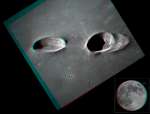 Messier Craters in Stereo
11.12.2009
Many bright nebulae and star clusters in planet Earth's sky are associated with the name of astronomer Charles Messier, from his famous 18th century catalog. His name is also given to these two large and remarkable craters on the Moon.
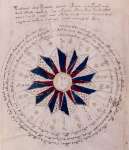 The Mysterious Voynich Manuscript
31.01.2010
The ancient text has no known title, no known author, and is written in no known language: what does it say and why does it have many astronomy illustrations? The mysterious book was once bought by an emperor, forgotten on a library shelf, sold for thousands of dollars, and later donated to Yale.
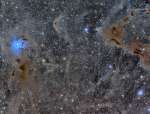 The Iris Nebula in a Field of Dust
24.06.2014
What flowers in this field of dark star dust? The Iris Nebula. The striking blue color of the Iris Nebula is created by light from the bright star SAO 19158 reflecting off of a dense patch of normally dark dust.
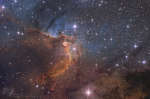 SH2 155: The Cave Nebula
5.11.2014
This colorful skyscape features the dusty Sharpless catalog emission region Sh2-155, the Cave Nebula. In the composite image, data taken through narrowband filters tracks the glow of ionized sulfur, hydrogen, and oxygen atoms in red, green, and blue hues.
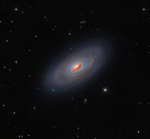 M64: The Black Eye Galaxy
18.06.2015
This big, bright, beautiful spiral galaxy is Messier 64, often called the Black Eye Galaxy or the Sleeping Beauty Galaxy for its heavy-lidded appearance in telescopic views. M64 is about 17 million light-years distant in the otherwise well-groomed northern constellation Coma Berenices.
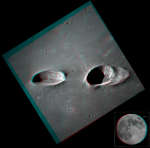 Messier Craters in Stereo
11.12.2020
Many bright nebulae and star clusters in planet Earth's sky are associated with the name of astronomer Charles Messier from his famous 18th century catalog. His name is also given to these two large and remarkable craters on the Moon.
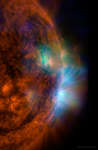 The Sun in X rays from NuSTAR
23.11.2021
Why are the regions above sunspots so hot? Sunspots themselves are a bit cooler than the surrounding solar surface because the magnetic fields that create them reduce convective heating. It is therefore unusual that regions overhead -- even much higher up in the Sun's corona -- can be hundreds of times hotter.
|
January February March April May |
|||||||||||||||||||||||||||||||||||||||||||||||||