
|
You entered: clouds
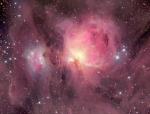 M42: Wisps of the Orion Nebula
25.02.2003
The Great Nebula in Orion, an immense, nearby starbirth region, is probably the most famous of all astronomical nebulas. Here, glowing gas surrounds hot young stars at the edge of an immense interstellar molecular cloud only 1500 light-years away. In the above deep image, faint wisps and sheets of dust and gas are particularly evident.
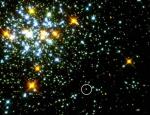 NGC 1818: Pick A Star
15.04.1998
This is NGC 1818, a youthful, glittering cluster of 20,000 stars residing in the Large Magellanic Cloud, 164,000 light-years away. Pick a star. Any star. Astronomers might pick the unassuming bluish-white one (circled) which appears to be a hot newly formed white dwarf star. What makes it so interesting?
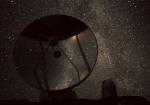 La Silla s Starry Night
23.09.2004
On clear, moonless nights, the stars still come out with a vengance above the high-altitude La Silla astronomical observatory. Taking advantage of a recent visit to this first European Southern Observatory (ESO) site constructed on a mountain top in Chile, ESO software engineer Nico Housen recorded this stunning sky view.
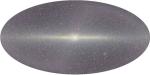 The Near Infrared Sky
18.05.2000
Was this picture taken from outside our Galaxy? No, it is a composite taken from Earth orbit, well inside our Milky Way Galaxy. In light just a little too red for human eyes...
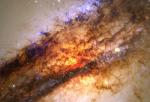 The Center of Centaurus A
22.08.1999
A fantastic jumble of young blue star clusters, gigantic glowing gas clouds, and imposing dark dust lanes surrounds the central region of the active galaxy Centaurus A. This mosaic of Hubble Space Telescope images taken in blue, green, and red light has been processed to present a natural color picture of this cosmic maelstrom.
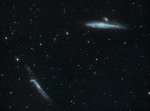 The Whale and the Hockey Stick
21.08.2009
NGC 4631 is a big beautiful spiral galaxy seen edge-on (top right) only 25 million light-years away towards the small northern constellation Canes Venatici. This galaxy's slightly distorted wedge shape suggests to some a cosmic herring and to others the popular moniker of The Whale Galaxy.
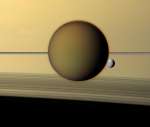 Ringside with Titan and Dione
5.01.2012
Orbiting in the plane of Saturn's rings, Saturnian moons have a perpetual ringside view of the gorgeous gas giant planet. Of course, while passing near the ring plane the Cassini spacecraft also shares their stunning perspective.
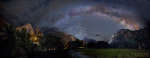 That Night over Half Dome
2.05.2014
Captured one night last May this eight frame mosaic starts on the left, down Northside Drive through Yosemite National Park. It ends thousands of light-years away though, as the arc of the Milky Way tracks toward the center of our galaxy on the right, far beyond the park's rugged skyline.
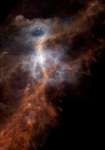 Herschel s Orion
14.10.2016
This dramatic image peers within M42, the Orion Nebula, the closest large star-forming region. Using data at infrared wavelengths from the Herschel Space Observatory, the false-color composite explores the natal cosmic cloud a mere 1,500 light-years distant.
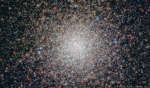 Star Cluster NGC 362 from Hubble
11.10.2017
If our Sun were near the center of NGC 362, the night sky would glow like a jewel box of bright stars. Hundreds of stars would glow brighter than Sirius, and in many different colors.
|
January February March April May June July August September |
|||||||||||||||||||||||||||||||||||||||||||||||||