
|
You entered: clouds
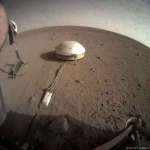 SEIS: Listening for Marsquakes
4.06.2019
If you put your ear to Mars, what would you hear? To find out, and to explore the unknown interior of Mars, NASA's Insight Lander deployed SEIS late last year, a sensitive seismometer that can detect marsquakes.
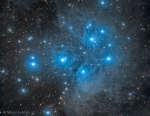 M45: The Pleiades Star Cluster
1.09.2019
Have you ever seen the Pleiades star cluster? Even if you have, you probably have never seen it as dusty as this. Perhaps the most famous star cluster on the sky, the bright stars of the Pleiades can be seen without binoculars from even the depths of a light-polluted city.
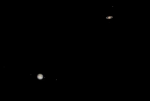 Jupiter and Saturn Great Conjunction: The Movie
30.12.2020
Yes, but have you seen a movie of Jupiter and Saturn's Great Conjunction? The featured time-lapse video was composed from a series of images taken from Thailand and shows the two giant planets as they angularly passed about a tenth of a degree from each other.
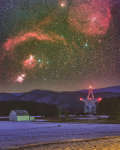 Orion over Green Bank
23.02.2022
What will the huge Green Bank Telescope discover tonight? Pictured, the Robert C. Byrd Green Bank Telescope (GBT) on the lower right is the largest fully-pointable single-dish radio telescope in the world. With...
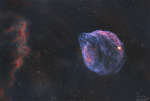 APOD: 2023 March 29 Б Sh2-308: A Dolphin Shaped Star Bubble
29.03.2023
Which star created this bubble? It wasn't the bright star on the bubble's right. And it also wasn't a giant space dolphin. It was the star in the blue nebula's center, a famously energetic Wolf-Rayet star.
 The SAR and the Milky Way
11.11.2023
This broad, luminous red arc was a surprising visitor to partly cloudy evening skies over northern France. Captured extending toward the zenith in a west-to-east mosaic of images from November 5, the faint atmospheric ribbon of light is an example of a Stable Auroral Red (SAR) arc.
 APOD: 2024 May 19 Б Jupiter Diving
19.05.2024
Take this simulated plunge and dive into the upper atmosphere of Jupiter, the Solar System's ruling gas giant. The awesome animation is based on image data from JunoCam, and the microwave radiometer on board the Jupiter-orbiting Juno spacecraft.
 Supernova Remnant CTA 1
23.08.2024
There is a quiet pulsar at the heart of CTA 1. The supernova remnant was discovered as a source of emission at radio wavelengths by astronomers in 1960 and since identified as the result of the death explosion of a massive star.
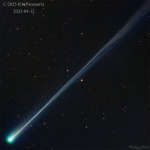 APOD: 2026 April 14 Б The Long Wispy Tail of Comet R3 (PanSTARRS)
14.04.2026
Why does Comet R3 (PanSTARRS) have a wispy tail? The newest bright member of the inner Solar System, Comet C/2025 R3 (PanSTARRS) is already extending an impressive stream of glowing gas. This tail starts from an unseen central nucleus of dirty ice that is likely a few kilometers across.
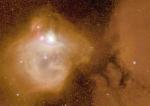 New Stars Destroying NGC 1748
3.04.2001
NGC 1748 cannot contain all the new stars it has formed. The young stars, the most massive of which are bright blue, emit so much energy they are pushing out and dispersing the gas and dust that comprise this star forming nebula.
|
January February March April May June July August September |
|||||||||||||||||||||||||||||||||||||||||||||||||