
|
You entered: clouds
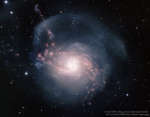 APOD: 2026 April 5 Б NGC 3310: A Starburst Spiral Galaxy
5.04.2026
The party is still going on in spiral galaxy NGC 3310. Roughly 100 million years ago, NGC 3310 likely collided with a smaller galaxy causing the large spiral galaxy to light up with a tremendous burst of star formation.
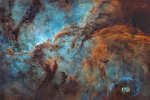 APOD: 2026 July 7 Б NGC 6188: Dragons of Ara
7.07.2026
Where can you find dragons fighting in the night sky? In the southern constellation of the Altar: Ara. The dragons are, of course, actually made of suggestively shaped gas and dust. The celestial home...
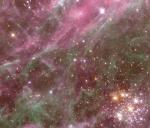 Denizen of the Tarantula Nebula
3.05.2003
The star cluster at lower right, cataloged as Hodge 301, is a denizen of the Tarantula Nebula. An evocative nebula in the southern sky, the sprawling cosmic Tarantula is an energetic star forming region some 168,000 light-years distant in our neighboring galaxy the Large Magellanic Cloud.
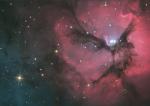 A Beautiful Trifid
1.09.2003
The beautiful Trifid Nebula (aka M20), a photogenic study in cosmic contrasts, lies about 5,000 light-years away toward the nebula rich constellation Sagittarius. A star forming region in the plane of our galaxy...
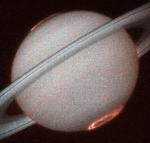 Saturnian Aurora
9.01.1998
Girdling the second largest planet in the Solar System, Saturn's Rings are one of the most spectacular sights for earthbound telescopes. This recently released image, from the orbiting Hubble Space Telescope's STIS instrument, offers a striking view of another kind of ring around Saturn - pole encircling rings of ultraviolet aurora.
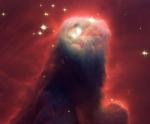 Cone Nebula Close Up
29.05.2004
Cones, pillars, and majestic flowing shapes abound in stellar nurseries where natal clouds of gas and dust are buffeted by energetic winds from newborn stars. A well-known example, the Cone Nebula within the bright galactic star-forming region NGC 2264, was captured in this close-up view from the Hubble Space Telescope's Advanced Camera for Surveys.
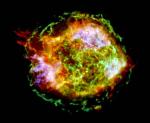 APOD: 2004 August 26- Cassiopeia A in a Million
26.08.2004
One million seconds of x-ray image data were used to construct this view of supernova remnant Cassiopeia A, the expanding debris cloud from a stellar explosion. The stunningly detailed image from the Chandra Observatory will allow an unprecedented exploration of the catastrophic fate that awaits stars much more massive than the Sun.
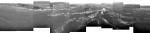 Eight Kilometers Above Titan
19.01.2005
What are these surface features on Titan? Scroll right to see the panoramic view captured last week by the Huygens probe as it descended toward Saturn's mysterious moon. Scientists are not yet sure what the above image is showing.
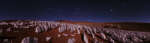 Night in the Andes Ice Forest
7.09.2013
This forest of snow and ice penitentes reflects moonlight shinning across the Chajnantor plateau. The region lies in the Chilean Andes at an altitude of 5,000 meters, not far from one of planet Earth's major astronomical observatories, the Atacama Large Millimeter/submillimeter Array.
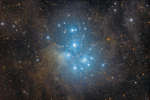 M45: The Pleiades Star Cluster
18.09.2013
Have you ever seen the Pleiades star cluster? Even if you have, you probably have never seen it as dusty as this. Perhaps the most famous star cluster on the sky, the bright stars of the Pleiades can be seen without binoculars from even the depths of a light-polluted city.
|
January February March April May June July August September |
|||||||||||||||||||||||||||||||||||||||||||||||||