
|
You entered: image
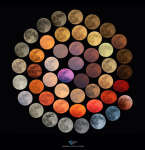 Colors of the Moon
14.05.2022
What color is the Moon? It depends on the night. Outside of the Earth's atmosphere, the dark Moon, which shines by reflected sunlight, appears a magnificently brown-tinged gray. Viewed from inside the Earth's atmosphere, though, the moon can appear quite different.
 APOD: 2024 January 7 Б The Cats Eye Nebula in Optical and X-ray
6.01.2024
To some it looks like a cat's eye. To others, perhaps like a giant cosmic conch shell. It is actually one of the brightest and most highly detailed planetary nebula known, composed of gas expelled in the brief yet glorious phase near the end of life of a Sun-like star.
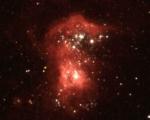 Bright Stars, Dim Galaxy
2.11.2001
These two clusters of bright, newly formed stars surrounded by a glowing nebula lie 10 million light-years away in the dim, irregular galaxy cataloged as NGC 2366. The Hubble Space Telescope image shows that...
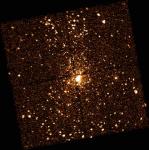 X-Ray Stars Of Orion
3.02.2000
The stars of Orion shine brightly in northern winter skies where the constellation harbors the closest large stellar nursery, the Great Nebula of Orion, a mere 1500 light-years away. In fact, the apparently bright...
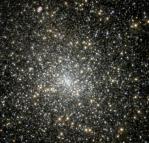 M15: Dense Globular Star Cluster
4.08.2000
Life might get dull at the core of M15 but the sky would always be bright with stars! In fact, only 40,000 light-years away in the constellation Pegasus, M15 is one of the most densely packed globular star clusters in our Milky Way Galaxy.
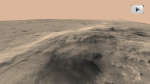 Flying Over the Columbia Hills of Mars
19.05.2008
What it would be like to fly over Mars? Combining terrain data from the orbiting Mars Global Surveyor spacecraft (now dormant) with information about the robotic Spirit rover currently rolling across Mars has resulted in a digital movie that shows what a flight over the Columbia Hills might look like.
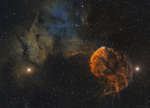 Sharpless 249 and the Jellyfish Nebula
6.03.2019
Normally faint and elusive, the Jellyfish Nebula is caught in this alluring telescopic field of view. The entire scene is a two panel mosaic constructed using narrowband image data, with emission from sulfur, hydrogen and oxygen atoms shown in red, green and blue hues.
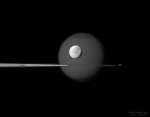 In, Through, and Beyond Saturn's Rings
3.04.2021
Four moons are visible on the featured image -- can you find them all? First -- and farthest in the background -- is Titan, the largest moon of Saturn and one of the larger moons in the Solar System. The dark feature across the top of this perpetually cloudy world is the north polar hood.
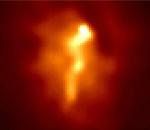 Abell 1795: A Galaxy Cluster s Cooling Flow
7.12.2000
Throughout the Universe, galaxies tend to swarm in groups ranging from just a handful of members to casts of thousands. Astronomers have realized since the early 1970s that the larger swarms, immense clusters of galaxies millions of light-years across, are immersed within tenuous clouds of hot gas which glow strongly in x-rays.
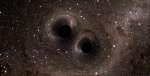 Simulation: Two Black Holes Merge
13.04.2019
Sit back and watch two black holes merge. Inspired by the first direct detection of gravitational waves in 2015, this simulation video plays in slow motion but would take about one third of a second if run in real time.
|
January February March April May June July August September |
|||||||||||||||||||||||||||||||||||||||||||||||||