
|
You entered: image
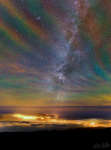 Rainbow Airglow over the Azores
22.03.2016
Why would the sky glow like a giant repeating rainbow? Airglow. Now air glows all of the time, but it is usually hard to see. A disturbance however -- like an approaching storm -- may cause noticeable rippling in the Earth's atmosphere.
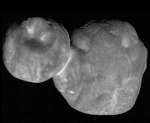 Sharpest Ultima Thule
28.02.2019
On January 1, New Horizons swooped to within 3,500 kilometers of the Kuiper Belt world known as Ultima Thule. That's about 3 times closer than its July 2015 closest approach to Pluto.
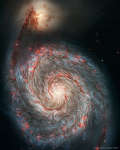 The Magnetic Field of the Whirlpool Galaxy
20.01.2021
Do magnetic fields always flow along spiral arms? Our face-on view of the Whirlpool Galaxy (M51) allows a spectacularly clear view of the spiral wave pattern in a disk-shaped galaxy. When observed with a radio telescope, the magnetic field appears to trace the arms' curvature.
 APOD: 2025 April 27 Б IC 418: The Spirograph Nebula
27.04.2025
What is creating the strange texture of IC 418? Dubbed the Spirograph Nebula for its resemblance to drawings from a cyclical drawing tool, planetary nebula IC 418 shows patterns that are not well understood. Perhaps they are related to chaotic winds from the variable central star, which changes brightness unpredictably in just a few hours.
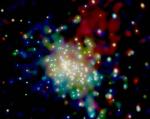 X Ray Mystery in RCW 38
27.12.2002
A mere 6,000 light-years distant and sailing through the constellation Vela, star cluster RCW 38 is full of powerful stars. It's no surprise that these stars, only a million years young with hot outer atmospheres, appear as point-like x-ray sources dotting this x-ray image from the orbiting Chandra Observatory.
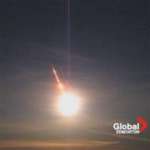 Fireball Over Edmonton
25.11.2008
What if you're driving down the street and an object from space shoots across the sky right in front of you? Such was the case last week for many people in south central Canada.
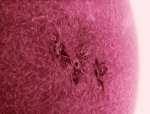 Angry Sun Erupting
14.03.2012
It's one of the baddest sunspot regions in years. Active Region 1429 may not only look, to some, like an angry bird -- it has thrown off some of the most powerful flares and coronal mass ejections of the current solar cycle.
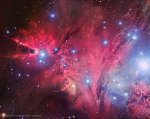 A Fox Fur, a Unicorn, and a Christmas Tree
4.01.2015
What do the following things have in common: a cone, the fur of a fox, and a Christmas tree? Answer: they all occur in the constellation of the unicorn (Monoceros). Pictured as a star...
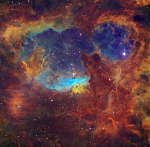 Massive Stars in NGC 6357
5.02.2016
Massive stars lie within NGC 6357, an expansive emission nebula complex some 6,500 light-years away toward the tail of the constellation Scorpius. In fact, positioned near center in this ground-based close-up...
 Supernova Remnant Cassiopeia A
17.01.2025
Massive stars in our Milky Way Galaxy live spectacular lives. Collapsing from vast cosmic clouds, their nuclear furnaces ignite and create heavy elements in their cores. After only a few million years for the most massive stars, the enriched material is blasted back into interstellar space where star formation can begin anew.
|
January February March April May June July August September |
|||||||||||||||||||||||||||||||||||||||||||||||||