
|
You entered: image
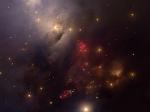 In the Center of Reflection Nebula NGC 1333
21.05.2007
The dust is so thick in the center of NGC 1333 that you can hardly see the stars forming. Conversely, the very dust clouds that hide the stars also reflects their optical light, giving NGC 1333's predominantly blue glow the general designation of a reflection nebula.
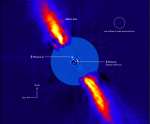 Probably a Planet for Beta Pic
28.11.2008
A mere 50 light-years away, young star Beta Pictoris became one of the most important stars in the sky in the early 1980s. Satellite and ground-based telescopic observations revealed the presence of a surrounding...
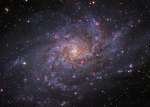 M33: Triangulum Galaxy
20.12.2012
The small, northern constellation Triangulum harbors this magnificent face-on spiral galaxy, M33. Its popular names include the Pinwheel Galaxy or just the Triangulum Galaxy. M33 is over 50,000 light-years in diameter, third largest in the Local Group of galaxies after the Andromeda Galaxy (M31), and our own Milky Way.
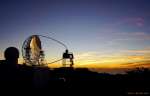 Cherenkov Telescope at Sunset
18.10.2018
On October 10, a new telescope reflected the light of the setting Sun. With dark horizon above and sunset colors below, its segmented mirror inverts an image of the beautiful evening sky in this snapshot from the Roque del Los Muchachos Observatory on the Canary Island of La Palma.
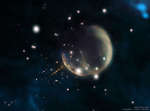 Supernova Cannon Expels Pulsar J0002
2.10.2022
What could shoot out a neutron star like a cannon ball? A supernova. About 10,000 years ago, the supernova that created the nebular remnant CTB 1 not only destroyed a massive star but blasted its newly formed neutron star core -- a pulsar -- out into the Milky Way Galaxy.
 APOD: 2024 July 2 Б NGC 602: Oyster Star Cluster
2.07.2024
The clouds may look like an oyster, and the stars like pearls, but look beyond. Near the outskirts of the Small Magellanic Cloud, a satellite galaxy some 200 thousand light-years distant, lies this 5 million year old star cluster NGC 602.
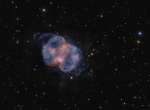 Messier 76
23.07.2010
"Nebula at the right foot of Andromeda ... " begins the description for the 76th object in Charles Messier's 18th century Catalog of Nebulae and Star Clusters. In fact, M76 is one of the fainter objects on the Messier list and is also known by the popular name of the "Little Dumbbell Nebula".
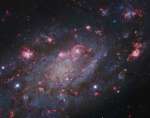 NGC 2403 in Camelopardalis
23.07.2011
Magnificent island universe NGC 2403 stands within the boundaries of the long-necked constellation Camelopardalis. Some 10 million light-years distant and about 50,000 light-years across, the spiral galaxy also seems to have more than its fair share of giant star forming HII regions, marked by the telltale reddish glow of atomic hydrogen gas.
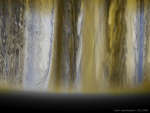 Jupiters Clouds from New Horizons
26.06.2016
The New Horizons spacecraft took some stunning images of Jupiter on its way out to Pluto. Famous for its Great Red Spot, Jupiter is also known for its regular, equatorial cloud bands, visible through even modest sized telescopes.
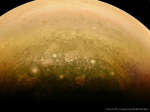 Clouds Near Jupiters South Pole from Juno
25.10.2016
What's happening near the south pole of Jupiter? Recent images sent back by NASA's robotic Juno spacecraft are showing an interesting conglomeration of swirling clouds and what appear to be white ovals.
|
January February March April May June July August September |
|||||||||||||||||||||||||||||||||||||||||||||||||