
|
You entered: image
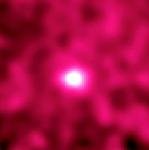 Gamma Ray Moon
17.04.1999
What if you could see gamma rays (photons with more than 40 million times the energy of visible light)? If you could, the Moon would appear brighter than the Sun! This startling notion...
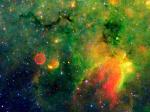 A Galactic Star Forming Region in Infrared
24.09.2007
How do stars form? To help study this complex issue, astronomers took a deep image in infrared light of an active part of our Milky Way Galaxy where star formation is rampant. In IRDC G11.11-0
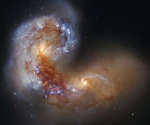 Spiral Galaxy NGC 4038 in Collision
12.08.2012
This galaxy is having a bad millennium. In fact, the past 100 million years haven't been so good, and probably the next billion or so will be quite tumultuous. Visible on the upper...
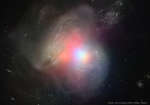 Arp 299: Black Holes in Colliding Galaxies
1.11.2016
Is only one black hole spewing high energy radiation -- or two? To help find out, astronomers trained NASA's Earth-orbiting NuSTAR and Chandra telescopes on Arp 299, the enigmatic colliding galaxies expelling the radiation.
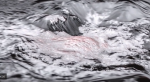 Salt Water Remnants on Ceres
1.09.2020
Does Ceres have underground pockets of water? Ceres, the largest asteroid in the asteroid belt, was thought to be composed of rock and ice. At the same time, Ceres was known to have unusual bright spots on its surface. These bright spots were clearly imaged during Dawn's exciting approach in 2015.
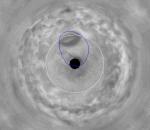 Jupiter's Great Dark Spot
19.03.2003
Seventeenth century astronomer Giovanni Domenico Cassini was an astute observer of Jupiter's Great Red Spot. So it seems only fitting that his namesake, the Cassini spacecraft, has enabled detailed observations of another planet-sized blemish -- Jupiter's Great Dark Spot.
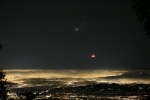 A Happy Sky Over Los Angeles
3.12.2008
Sunday, the sky seemed to smile over much of planet Earth. Visible the world over was an unusual superposition of our Moon and the planets Venus and Jupiter. Pictures taken at the right time...
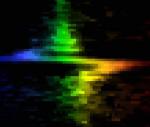 Signed, "A Black Hole"
16.05.1997
This artistic image is actually the signature of a supermassive black hole in the center of distant galaxy M84 - based on data recently recorded by Hubble's new Space Telescope Imaging Spectrograph (STIS). Very...
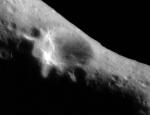 Eros From Orbit
16.02.2000
On February 14th, the NEAR spacecraft became the first artificial moon of an asteroid. Captured by the gentle gravity of a 20 mile long slipper-shaped mountain of rock, NEAR recorded this premier image while orbiting asteroid 433 Eros at a distance of about 200 miles.
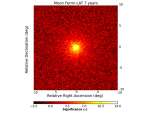 Fermi s Gamma-ray Moon
29.04.2016
If you could only see gamma-rays, photons with up to a billion or more times the energy of visible light, the Moon would be brighter than the Sun! That startling notion underlies this novel...
|
January February March April May June July August September |
|||||||||||||||||||||||||||||||||||||||||||||||||