
|
You entered: sky
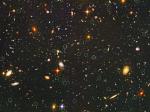 HUDF: Dawn of the Galaxies
29.09.2004
When did galaxies form? Faint red smudges identified on the deepest optical sky image ever taken may well be members of the first class of galaxies. Detailed inspection of the Hubble Ultra Deep Field...
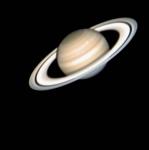 A New Storm on Saturn
27.01.2006
Presently at opposition in planet Earth's sky, Saturn is well placed for telescopic observations. On Wednesday two amateur astronomers took full advantage of the situation from Melun, near Paris, France. With...
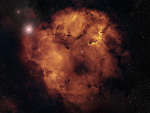 Monsters of IC 1396
25.04.2011
Is there a monster in IC 1396? Known to some as the Elephant's Trunk Nebula, parts of the glowing gas and dust clouds of this star formation region may appear to take on foreboding forms, some nearly human. The entire nebula might even look like a face of a monster.
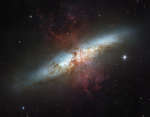 M82: Galaxy with a Supergalactic Wind
26.03.2012
What's lighting up the Cigar Galaxy? M82, as this irregular galaxy is also known, was stirred up by a recent pass near large spiral galaxy M81. This doesn't fully explain the source of the red-glowing outwardly expanding gas, however.
 Discovery Departs
19.04.2012
Climbing into cloudy skies, the Space Shuttle Orbiter Discovery (OV-103) took off from Kennedy Space Center Tuesday at 7 am local time. This time, its final departure from KSC, it rode atop a modified Boeing 747 Shuttle Carrier Aircraft.
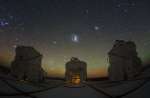 3 ATs
3 ATs
21.04.2012
Despite their resemblance to R2D2, these three are not the droids you're looking for. Instead, the enclosures house 1.8 meter Auxiliary Telescopes (ATs) at Paranal Observatory in the Atacama Desert region of Chile.
 The Witch Head Nebula
30.10.2015
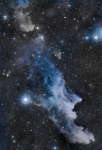
Double, double toil and trouble; Fire burn, and cauldron bubble .... maybe Macbeth should have consulted the Witch Head Nebula. A suggestively shaped reflection nebula, this cosmic crone is about 800 light-years away though. Its frightening visage seems to glare toward nearby bright star Rigel in Orion, just off the right edge of this frame.
 Leonids Over Monument Valley
15.11.2015
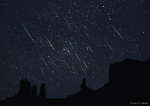
There was a shower over Monument Valley -- but not water. Meteors. The featured image -- actually a composite of six exposures of about 30 seconds each -- was taken in 2001, a year when there was a very active Leonids shower.
 Blue Danube Analemma
29.07.2016
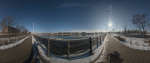
The Sun's annual waltz through planet Earth's sky forms a graceful curve known as an analemma. The analemma's figure 8 shape is tipped vertically at far right in this well-composed fisheye view from Budapest, Hungary.
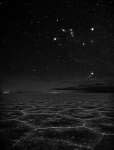 Luminous Salar de Uyuni
15.04.2017
A scene in high contrast this thoughtful night skyscape is a modern composition inspired by M. C. Escher's lithograph Phosphorescent Sea. In it, bright familiar stars of Orion the Hunter and Aldebaran, eye of Taurus the Bull, hang in clear dark skies above a distant horizon.
|
January February March April May June July August September October |
|||||||||||||||||||||||||||||||||||||||||||||||||