
|
You entered: sky
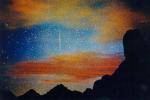 Leonid Sunrise
17.11.2000
Such beautiful things begin as grains of sand. Locked in an oyster a granule grows into an iridescent pearl, lustrous and lovely to behold. While hurtling through the atmosphere at 70 kilometers per second, a cosmic sand grain becomes an awe-inspiring meteor, its transient beauty displayed for any who care to watch.
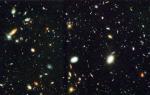 The Hubble Deep Field
9.07.2000
Galaxies like colorful pieces of candy fill the Hubble Deep Field - one of humanity's most distant optical views of the Universe. The dimmest, some as faint as 30th magnitude (about four billion times...
 The Milky Way Near the Northern Cross
15.05.1996
This beautiful image of the sky near the bright star Deneb (just above center) reveals the stars, nebulae, and dark clouds along the plane of our Milky Way Galaxy as seen from the northern hemisphere (near Columbia Missouri, USA). Just below Deneb lies the suggestively shaped North American emission nebula.
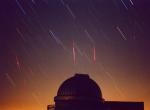 2001 Leonids: Meteors in Perspective
7.11.2002
The 2001 Leonid storm was so intense that the meteor shower's radiant, the point on the sky from which the fleeting trails seemed to diverge, was easy to spot. But the bits of debris that created the meteors really moved along parallel paths, following the orbit of their parent comet Tempel-Tuttle.
 Ice Fishing for Cosmic Neutrinos
3.08.2003
Scientists are melting holes in the bottom of the world. In fact, several holes have been melted near the South Pole, and they are now being used as astronomical observatories. Astronomers with the Antarctic Muon and Neutrino Detector Array (AMANDA) lower into each vertical lake a string knotted with basketball-sized light detectors.
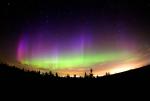 Northern Lights
30.07.2004
While enjoying the spaceweather on a gorgeous summer evening in mid-July, astronomer Philippe Moussette captured this colorful fish-eye lens view looking north from the Observatoire Mont Cosmos, Quebec, Canada, planet Earth. In the foreground, lights along the northern horizon give an orange cast to the low clouds.
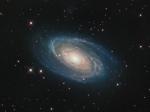 Bright Galaxy M81
7.07.2006
Big and beautiful spiral galaxy M81 lies in the northern constellation Ursa Major. One of the brightest galaxies in planet Earth's sky, M81 is also home to the second brightest supernova seen in modern times.
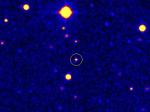 Mystery Object Explained
28.09.1999
Explorers often discover the unexpected. Such was the case when the Second Palomar Observatory Sky Survey chanced upon the unusual object circled in the above photograph. The so-called mystery object appeared star-like but displayed colors unlike most stars or quasars.
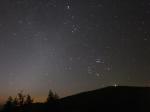 Mysterious Streaks Over Turkey
15.08.2007
What are they? Five streaks near the bottom of the above image taken near Ankara, Turkey on Sunday would be identified at first glance as meteors from the Perseids meteor shower peaking just that night. Unexpectedly, however, these streaks do not point back to the Perseids radiant in Perseus. Their origin is therefore somewhat unclear.
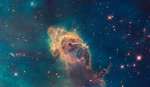 Carina Pillar and Jets
1.10.2009
This cosmic pillar of gas and dust is nearly 2 light-years wide. The structure lies within one of our galaxy's largest star forming regions, the Carina Nebula, shining in southern skies at a distance of about 7,500 light-years.
|
January February March April May June July August September October |
|||||||||||||||||||||||||||||||||||||||||||||||||